Is NSOCKS legit? How to verify any proxy provider
Is NSOCKS legit? A provider earns that label when its company details, IP sourcing, policies, and support record can all be checked against public sources. This guide gives a provider-agnostic method first, then applies that to NSOCKS with links to our pages.
Legend used on this page: ✅ documented and published · ❌ missing or unpublished · ⚠️ published with limits · 💡 practical tip. No other marks are used.
What legitimacy means for a proxy provider
Legitimacy is not a marketing badge. It rests on three layers: a real registered company, honesty about where IP addresses come from, and a support process that actually responds. A NSOCKS proxy buyer, or a buyer of any other service, should confirm all three before paying.
💡 Tip: start with the domain, not the homepage copy. A registered entity, a matching WHOIS record and a working support channel tell you more than any testimonial.
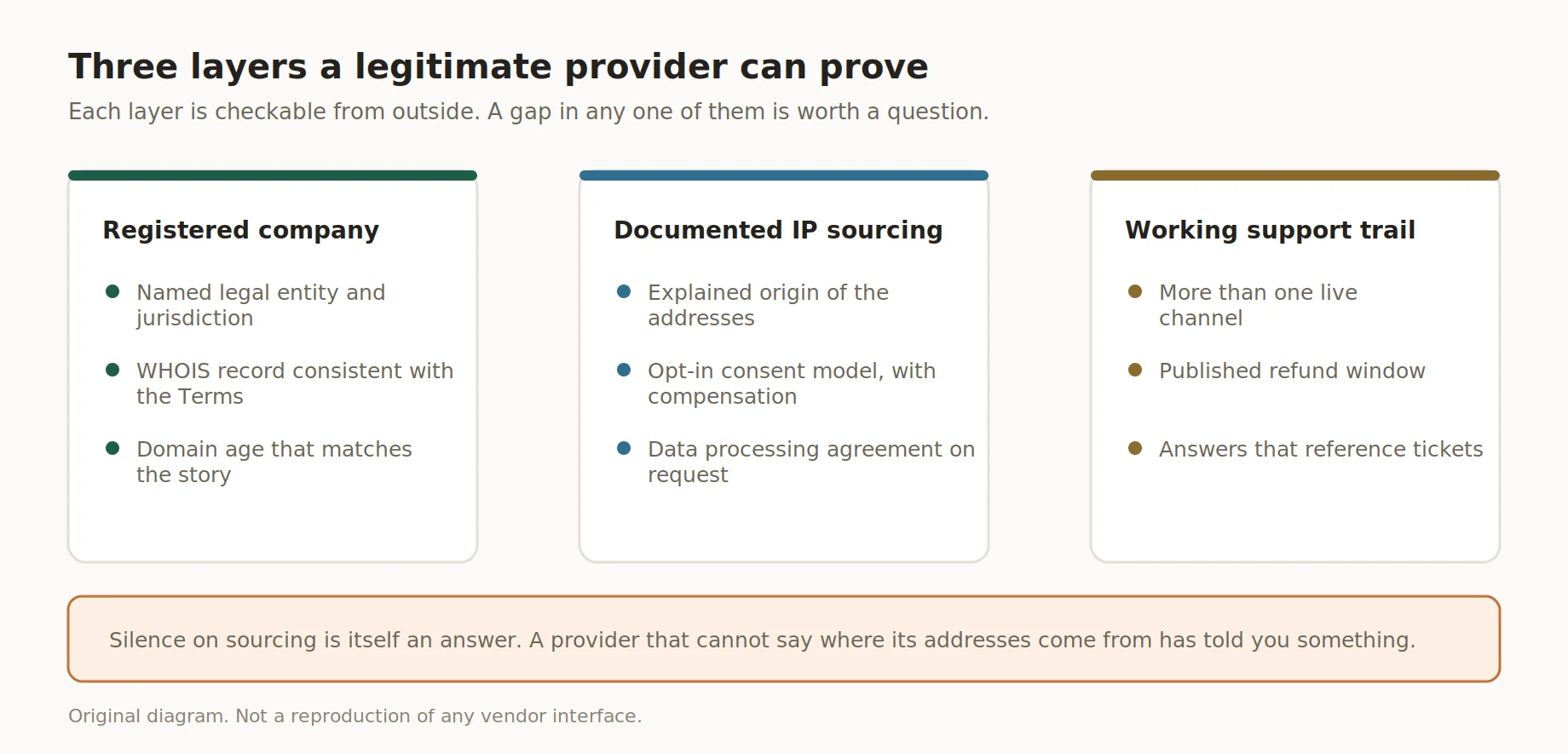
Three layers a legitimate provider can prove
The seven-point legitimacy checklist
Seven checks cover almost every proxy provider on the market, no matter the price point or region it targets. Run through them once and reuse the same table for the next vendor you evaluate. None require paid tools, only a browser and a few minutes. Revisit the table before every renewal, not only the first purchase.
| Check | How to verify | Good answer looks like |
|---|---|---|
| Company & domain | Match whois record against Terms | Named entity, matching domain age |
| IP origin and consent | Search the sourcing page | Opt in language, mention of pay |
| Terms and AUP | Open Terms, Privacy, AUP | Published, dated, no login needed |
| Payment and refunds | Read the billing section | Refund policy with timeframes |
| Support speed | Open a ticket, check contacts | More than one channel, stated time |
| Documentation | Check help center depth | Step-by-step, not just marketing |
| Independent reviews | Search Trustpilot and forums | Mix of detailed praise and gripes |
IP sourcing and consent policy
Is NSOCKS safe to route real traffic through comes down to one question: where do the IPs originate. A provider that explains sourcing, names the consent model and offers a data processing agreement gives you something to check. One that stays vague has already answered the question, just not in words.
Ethical sourcing means the device owner agreed to share bandwidth and got something back, a paid tier or direct payment. Look for opt in consent wording on the provider's pages, not a generic privacy note. A published data processing agreement signals a contractual obligation. If none of this is published, that silence is the answer.
Documents a provider should publish
A provider that expects long-term customers should publish the paperwork those customers need for a dispute. This is not about volume; a short, dated document beats a vague one padded with filler. The absence of any item below is a fair reason to ask questions.
These documents sit alongside the technical checks above, forming the paper trail behind any acceptable use policy claim. Together they let a NSOCKS proxy buyer confirm rules before paying.
- ✅ Terms of service, naming the legal entity and jurisdiction
- ✅ Privacy policy describing data handling
- ✅ Acceptable use policy defining allowed and forbidden activity
- ✅ Refund policy with clear timeframes
- ✅ Contact details tied to a real support channel
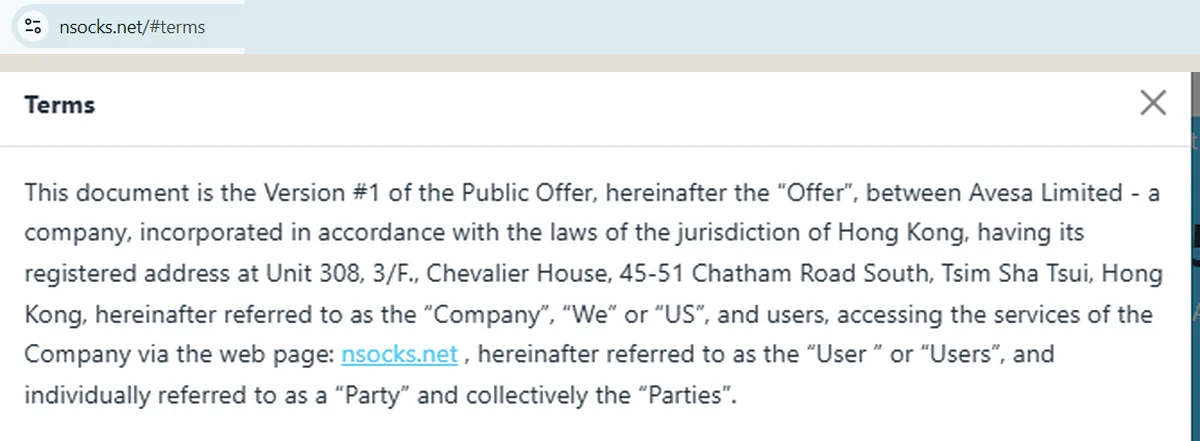
Source: Public Offer, legal entity clause, nsocks.net/#terms, screenshot taken 21.08.2026
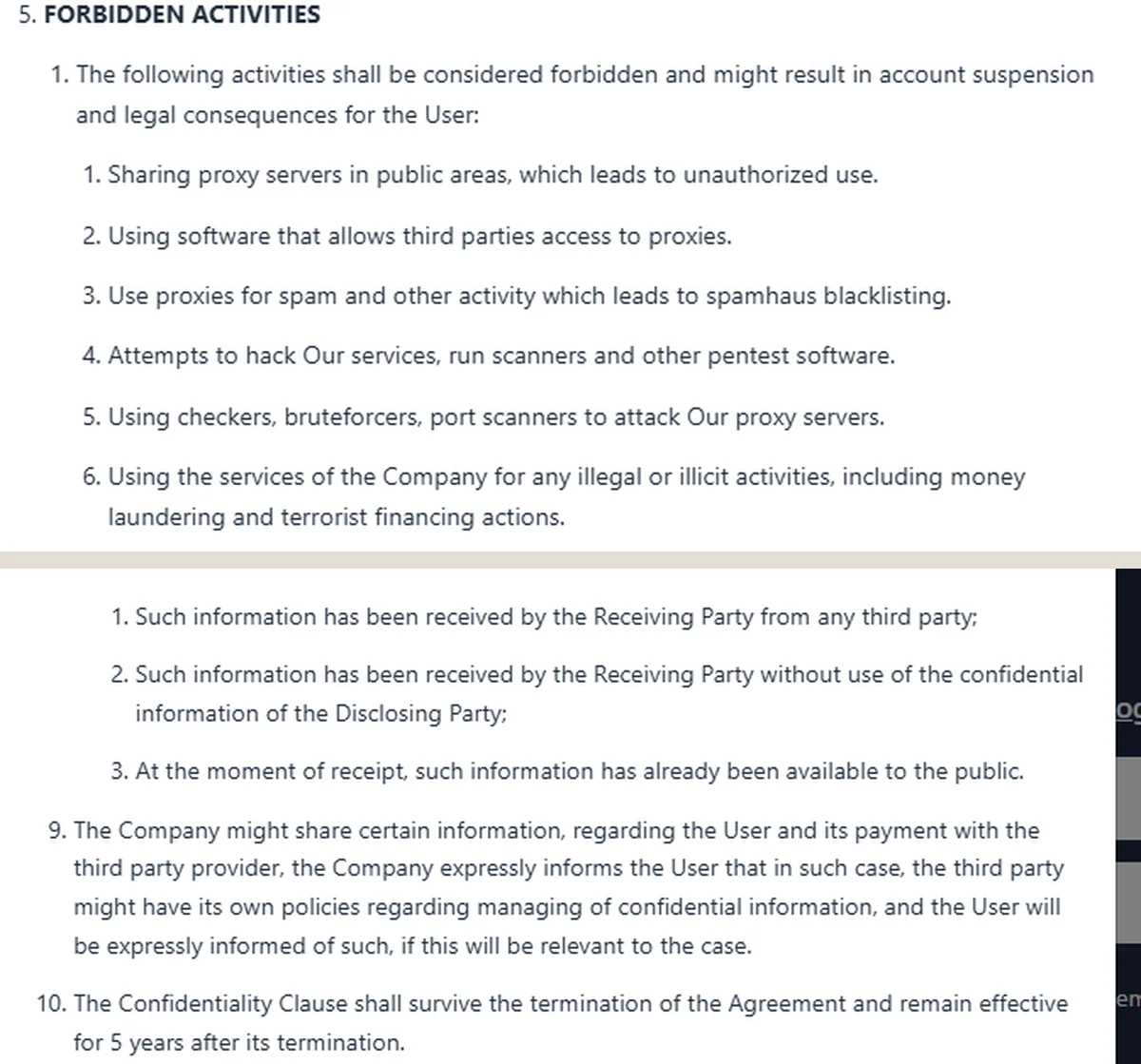
Source: Public Offer, sections 5 and 12, nsocks.net/#terms, screenshot taken 21.08.2026
How to read independent reviews
A single NSOCKS review rarely tells the full story, so treat one post as a data point, not a verdict. What matters more is the pattern across dozens: repeated complaints carry weight, while a wall of near-identical five-star posts is a reason to slow down. Vendor replies to negative posts often reveal more than the review text itself.
💡 Tip: sort by lowest rating first. A company answering critical NSOCKS reviews with ticket numbers and next steps behaves differently from one posting a generic thank-you note.
Some comparison sites run on affiliate links, and payouts can quietly shape which vendor gets featured first on a ranked list, sometimes ahead of genuinely better options, without that arrangement ever being disclosed near the ranking itself. A detailed NSOCKS review on a moderated, independently run platform carries more weight than a glowing post on an unfamiliar blog with no visible ownership.
How to run a technical trust test
Numbers beat impressions, and a short test run gives real numbers before a bigger buy. The steps below apply to any proxy service, not only NSOCKS, and take under an hour with free tools. Run the batch on a fresh account, away from production. Skipping this is how buyers pay twice for the same mistake.
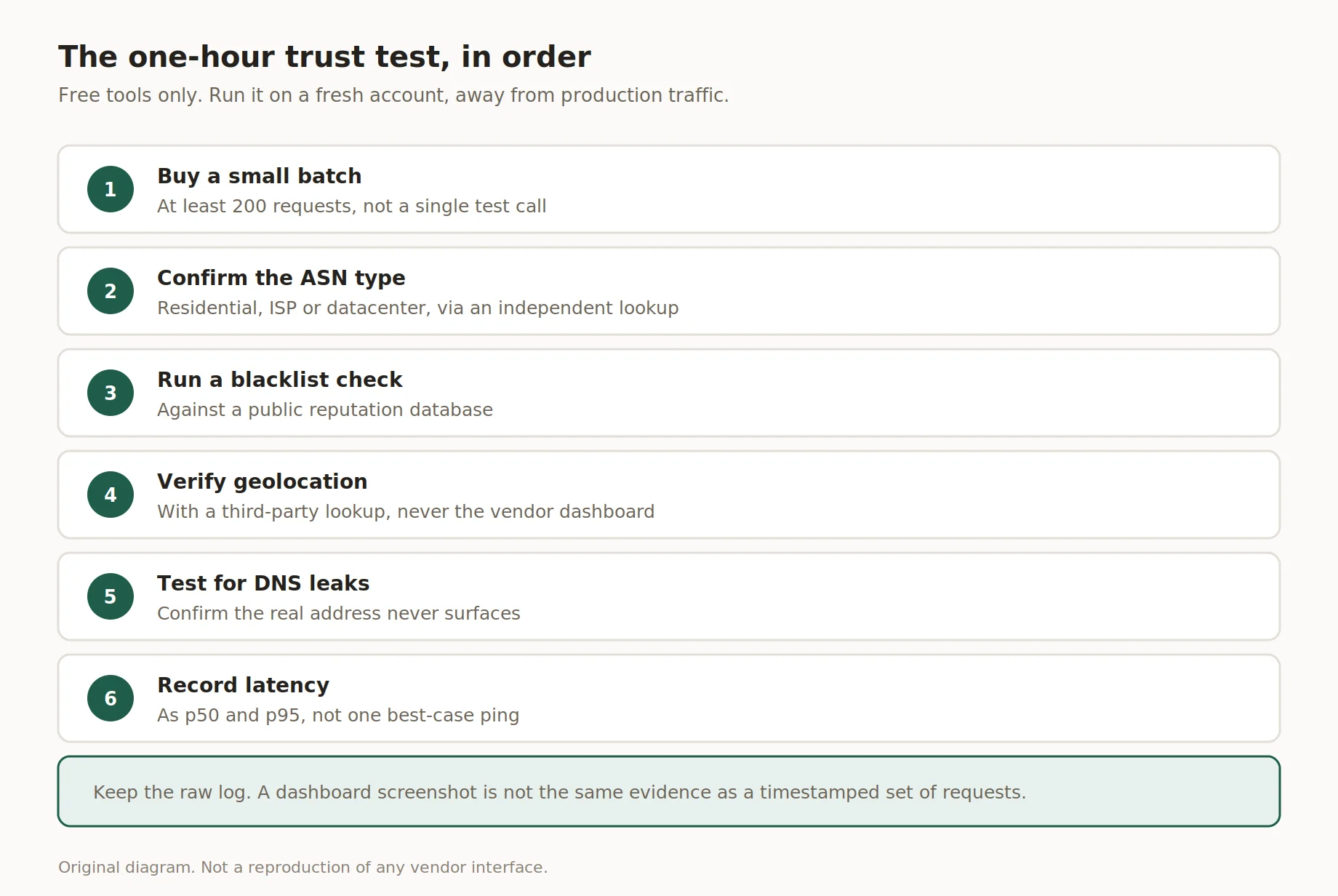
The one-hour trust test, in order
- Trial a small batch, at least 200 requests, before a larger order
- Check the ASN type via IPinfo or a similar lookup to confirm residential or ISP class
- Run a blacklist check against Spamhaus or a comparable database
- Confirm geo-accuracy with an independent IP lookup tool, not the vendor's dashboard
- Test for DNS leaks to confirm your real address never surfaces
- Record latency as p50 and p95, not one best-case ping
Red flags to note
None of the signals below name a specific company; they describe patterns worth checking before committing a budget. A single flag isn't disqualifying on its own, but two or three together are worth a pause.
This moves from theory to a short table, linking the logic above to real outcomes. Treat the right column as a starting action.
| Red flag | Why it matters | What to do |
|---|---|---|
| No answer on sourcing | Origin may involve unconsented devices | Ask directly, request the sourcing page |
| Price far below market | Real bandwidth has a cost | Compare several vendors, not one outlier |
| Missing refund policy | No recourse if service fails | Check billing terms before paying |
| Only similar-worded reviews | Typical of incentivized feedback | Read the lowest-rated reviews first |
How NSOCKS answers these checks
Disclosure: NSOCKS is our service, this section is self-reported and linked to our own pages. The goal is to answer the same seven points asked of any vendor.
On transparency, is NSOCKS legit starts with the Public Offer, naming Avesa Limited, incorporated under the laws of Hong Kong and registered at Unit 308, 3/F., Chevalier House, 45-51 Chatham Road South, Tsim Sha Tsui, as the operating entity. On sourcing, our IPs come from ISP peering and device partnerships rather than unexplained bulk lists; a full consent breakdown per IP class is not published on one page today, and we say so plainly.
On documents, the Public Offer is published in full at nsocks.net/#terms and carries a version number rather than a date, which we would rather see changed. Acceptable use sits inside it as section 5, Forbidden Activities, and the no-log commitment as section 12, Confidentiality, rather than as separate standalone documents.
On payment, the Offer states that we currently accept Bitcoin and Litecoin, with other methods possible through certified payment gateways subject to confirmation for a specific user, and every transaction passes an AML check run by a third-party KYC provider. On refunds, the button is available if a proxy goes offline within two hours of purchase, a support ticket has to be opened within five hours, a flat $50 fee covers manual processing, and refunds for transfer mistakes start at $150.
Reasons that are not accepted, such as a high fraud score or a block on one specific site, are listed in the same section. On support, tickets and Telegram are the main channels; no customer support SLA is published beyond the refund windows in the same document. The same terms cover every product line, from residential to ISP and static addresses.
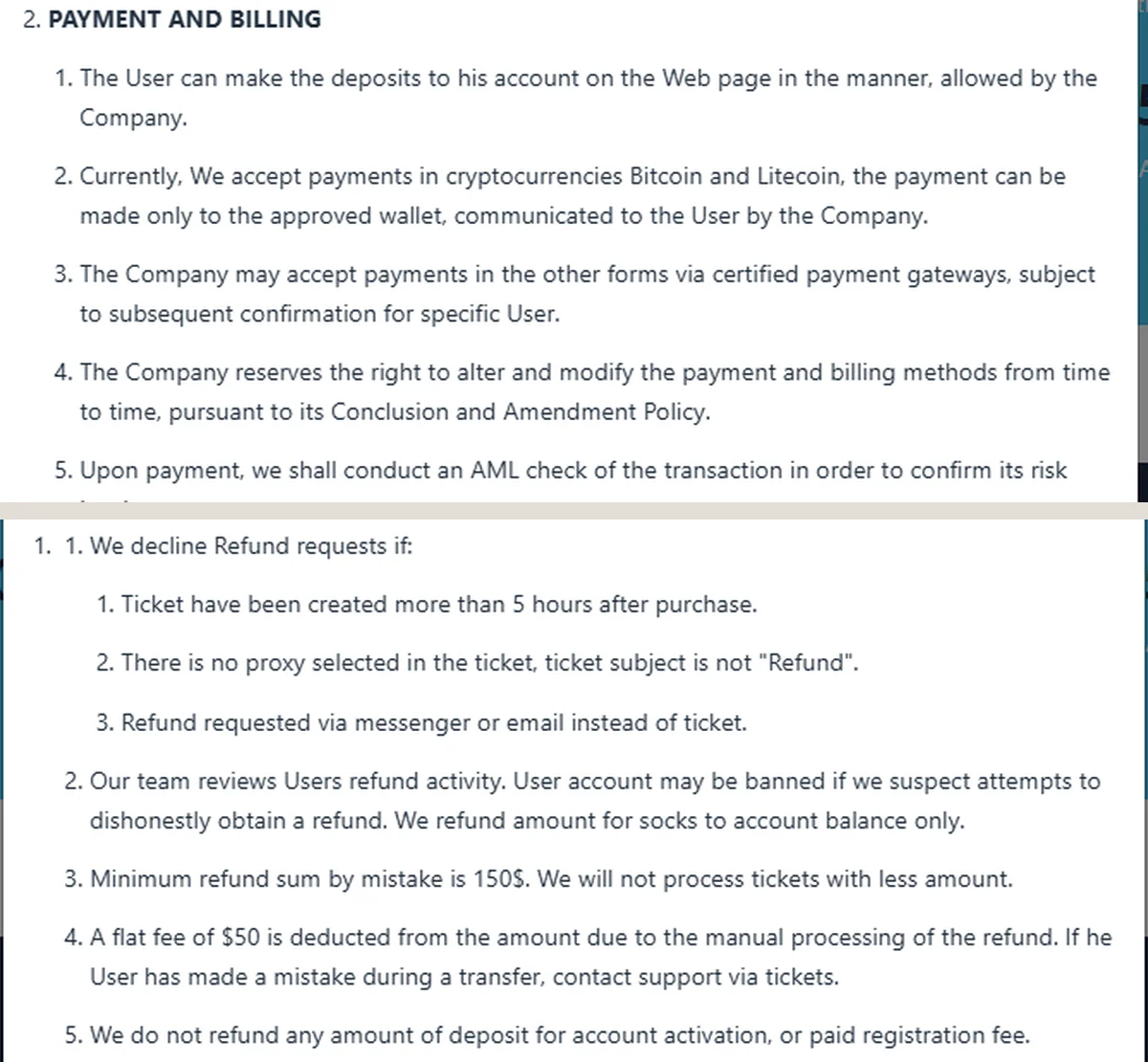
Source: Public Offer, Payment and Billing and Refund Policy, nsocks.net/#terms, screenshot taken 21.08.2026
Anyone still asking is NSOCKS legit after reading the Terms can also test the network directly through a demo, at no cost, before funding an account. Try the demo or register for full access.
Key takeaways
Five points summarize the method above, distilled from every section before this one, worth a skim before funding any account.
- Is NSOCKS legit hinges on checkable facts: registered entity, published policies, documented sourcing, and a support trail.
- Run the seven-point checklist on any vendor before paying, not only on NSOCKS.
- IP sourcing and an opt in consent model matter as much as speed or price.
- Read the lowest-rated reviews first; vendor replies reveal more than star counts.
- A short trial, with blacklist check and ASN type confirmed, beats guessing from a sales page.
Disclosure and data sources
This article is published by NSOCKS to help answer is NSOCKS legit with checkable facts rather than marketing claims. The checklist itself is provider-agnostic; the section on how NSOCKS answers it is self-reported and links to our own pages as of August 2026.
NSOCKS is not affiliated with any other provider or platform referenced here. Trademarks belong to their owners, and pricing or refund windows may change, so check the live Terms page for the current version.
Public reviews on independent platforms form one more input alongside the documents linked above. They are not reproduced here, because ratings change continuously; read them directly on the platform and weigh them against the seven-point method rather than against a star count.
Frequently asked questions
The questions below cover what buyers ask most before funding an account. Each answer stays short on purpose. Treat the sections above as the fuller explanation.
How can I tell if a proxy provider is legit?
Check the registered company, published policies, where its IPs come from, and independent reviews together.
What documents should a proxy provider publish?
Terms of service, a privacy policy, rules for acceptable use, and a policy covering refunds.
Why does IP sourcing matter?
It shows whether device owners consented and were compensated for shared bandwidth.
How do I test proxy quality before a big purchase?
Run a small trial batch, check the ASN classification, blacklist status and latency as p50 and p95.
Are free trials a sign of a trustworthy provider?
A free trial helps, but it should sit alongside published policies, not replace them.
What should I do if a provider will not answer sourcing questions?
Treat the silence as an answer and compare against a provider that discloses sourcing openly.