LunaProxy alternatives: proxy providers compared
Teams researching LunaProxy alternatives usually weigh pool size, protocol support, and billing unit against one real workload. This guide compares four public-pricing providers plus NSOCKS, using service model, proxy types, protocols, and entry price as criteria. Every figure below traces to a provider's own page.
LunaProxy alternatives compared
Comparing LunaProxy alternatives side by side only works if every provider faces the same criteria. Below, LunaProxy sits next to IPRoyal, Oxylabs, Decodo, and NSOCKS, picked because each publishes real prices, not sales-call quotes. Data as of Aug 2026.
| Provider | Service model | Proxy types | Protocols | Billing unit | Entry price |
|---|---|---|---|---|---|
| LunaProxy | Per-IP, per-GB, monthly ISP | Residential, static ISP | SOCKS5, HTTP(S) | IP/GB/IP-month | $0.24/IP at 150 IPs ⚠️ 30% sale applied; $0.05/IP only at 9000 IPs |
| IPRoyal | Subscription + PAYG | Residential, ISP, datacenter, mobile | HTTP, HTTPS, SOCKS5 | GB / proxy | $7.00/GB (1GB) |
| Oxylabs | Subscription tiers | Residential, ISP, dedicated ISP, datacenter, mobile | HTTP, HTTPS, SOCKS5; UDP not documented | GB / IP | $6.00/GB (5GB) |
| Decodo | Subscription + PAYG | Residential, ISP, mobile, datacenter | HTTP(S), SOCKS5 | GB | $3.75/GB (3GB) ⚠️ banner: $2/GB |
| NSOCKS | Per-IP, PAYG only | SOCKS5 shop, residential, mobile, ISP, static, UDP | SOCKS5, SOCKS5 UDP | IP per 24h | $0.40/IP/24h |
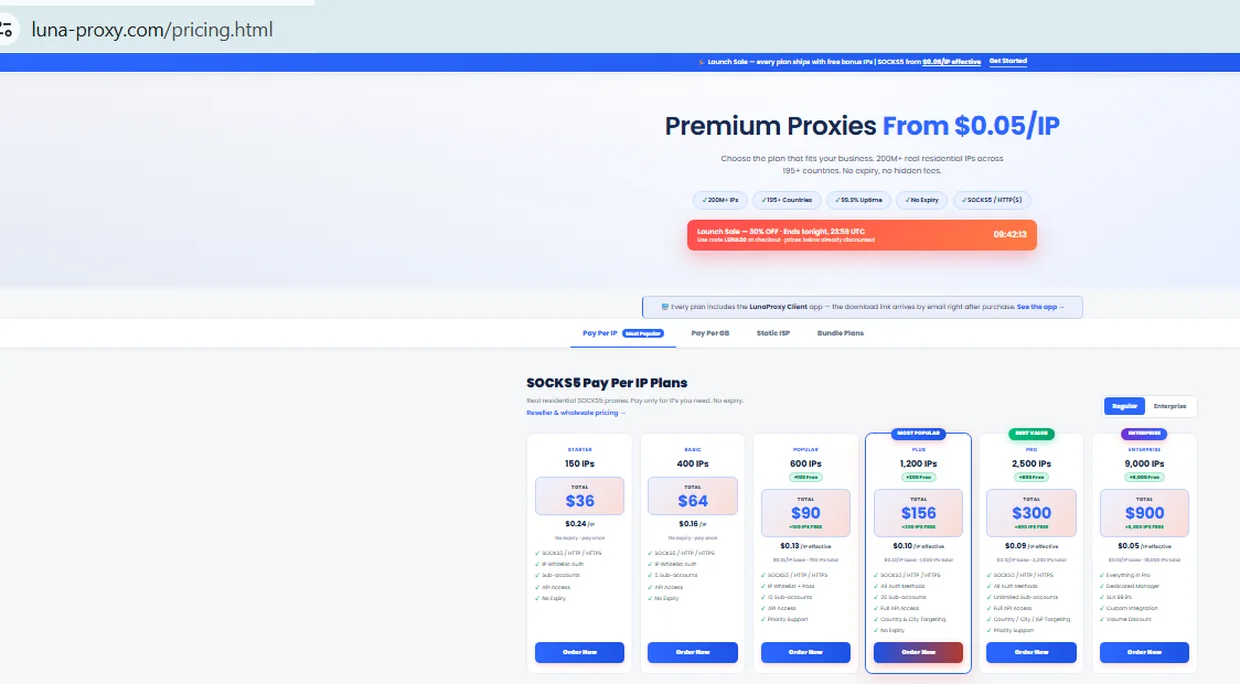
Source: SOCKS5 Pay Per IP Plans, luna-proxy.com/pricing.html, screenshot taken August 2026
The headline rate of $0.05 per IP is the effective price on the 9000 IP Enterprise plan, not an entry point. The Starter plan is 150 IPs for $36, which works out at $0.24 per IP. Every figure on the page already includes a 30 percent launch sale applied at checkout with a code, so treat the whole table as promotional. Country and city targeting appears from the 800 IP plan upward, and ISP targeting from 2500 IPs, so the targeting column depends on the tier rather than the provider.
Why teams look for an alternative and how this list was built
Most people reading up on a LunaProxy alternative are not unhappy customers; they are matching a provider to a billing shape their workflow runs on. A team billed by IP count does not want a per-GB dashboard, and one running SOCKS5 does not want a rebuild around a new manager.
This list applies three filters before anything else: a public price page, SOCKS5 in the documentation, and residential proxies in the lineup. Many residential proxy providers skip at least one of those basics on their own homepage, so providers without a public price were left out entirely.
💡 Tip: match a provider by billing unit first, features second.
Alternatives for rotating residential pools
For rotating residential pools, Luna Proxy, IPRoyal, Oxylabs, and Decodo publish per-GB pricing, while NSOCKS lists residential without a published GB rate here. Pool size ranges from IPRoyal's 64M+ up to LunaProxy's 200M+, though advertised and usable ip pool size in one city differ. Sticky sessions and rotation settings also vary by provider, so check those before committing to a plan.
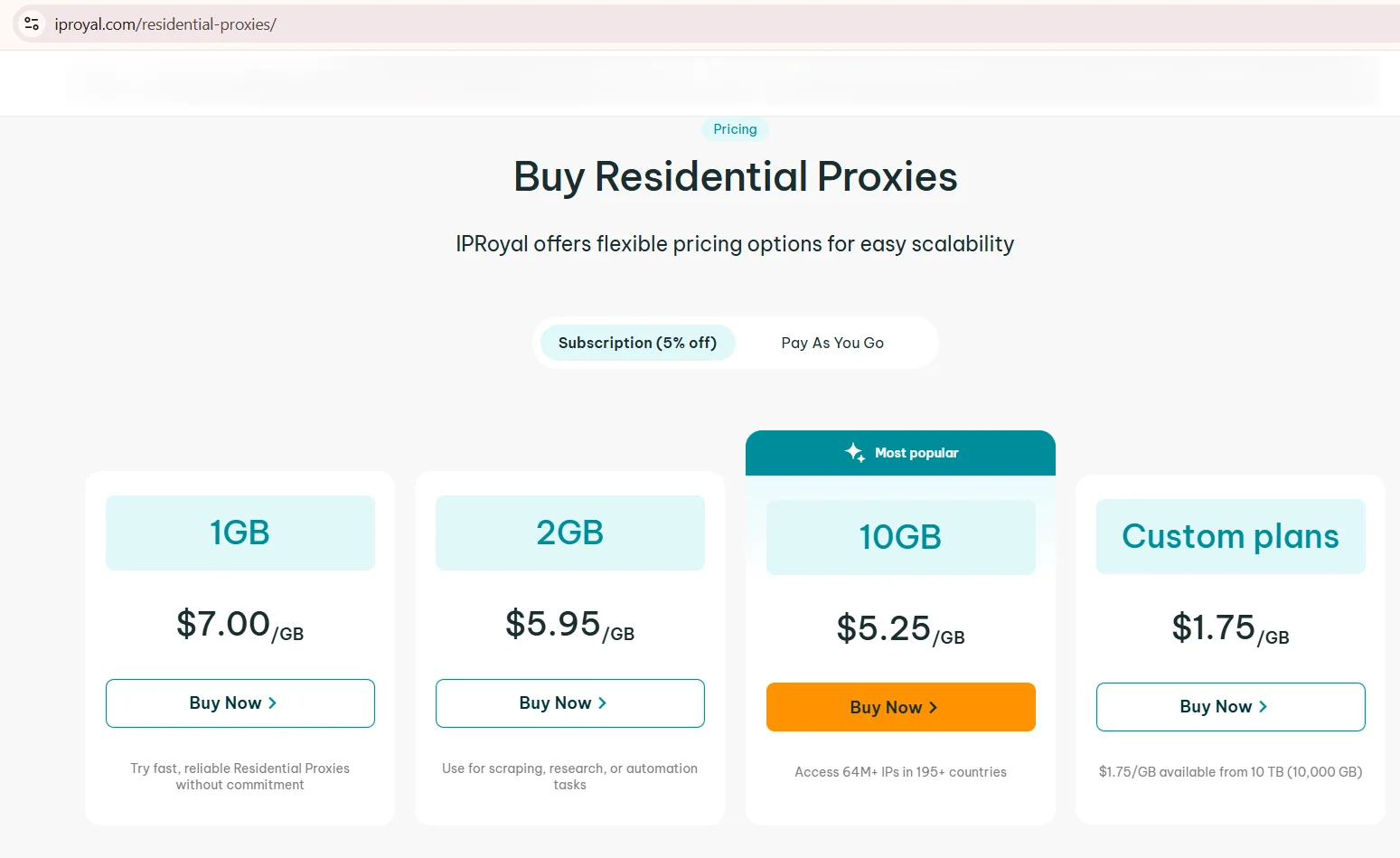
Source: Buy Residential Proxies, Subscription tab, iproyal.com, screenshot taken August 2026
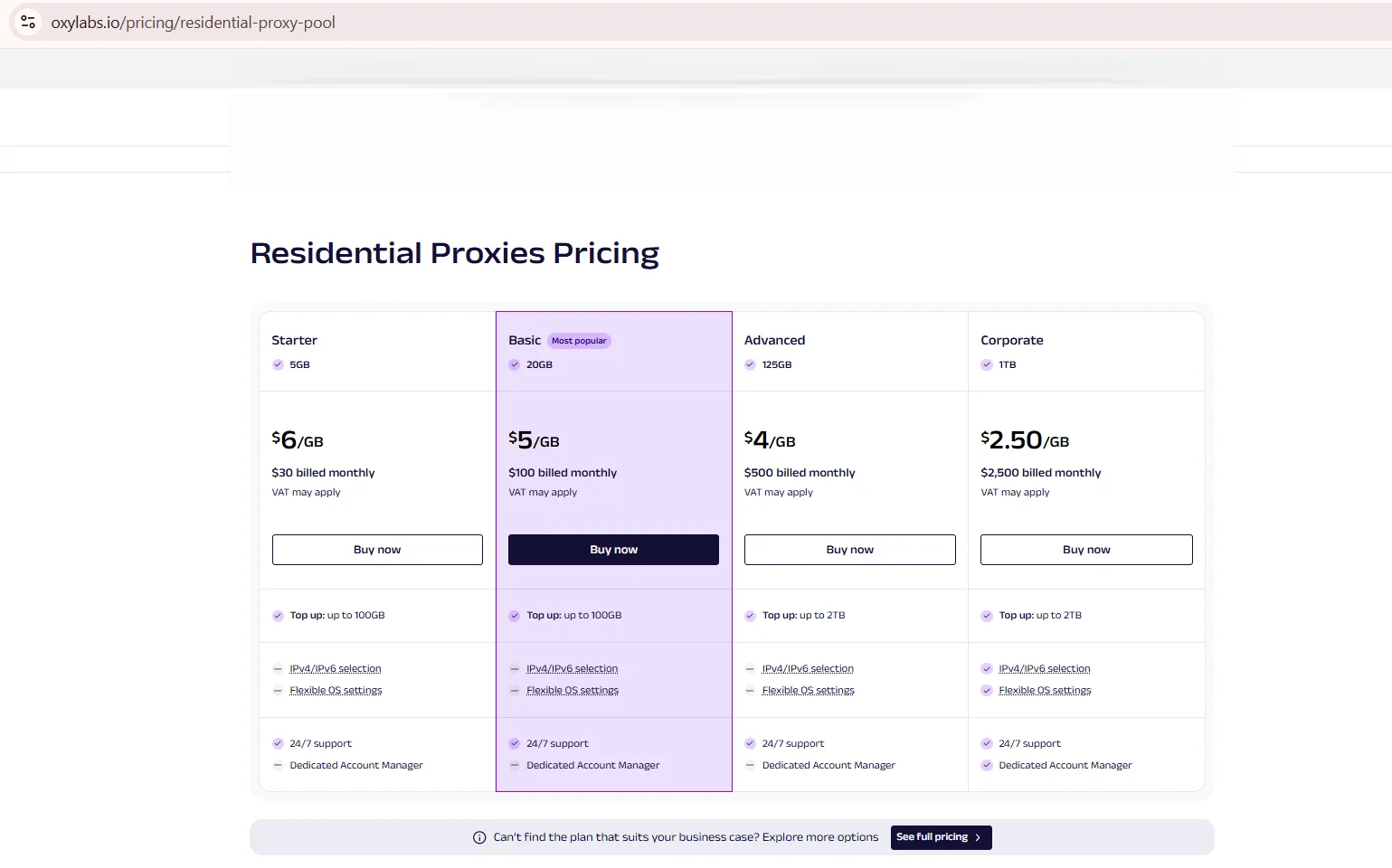
Source: Residential Proxies Pricing, oxylabs.io, screenshot taken August 2026
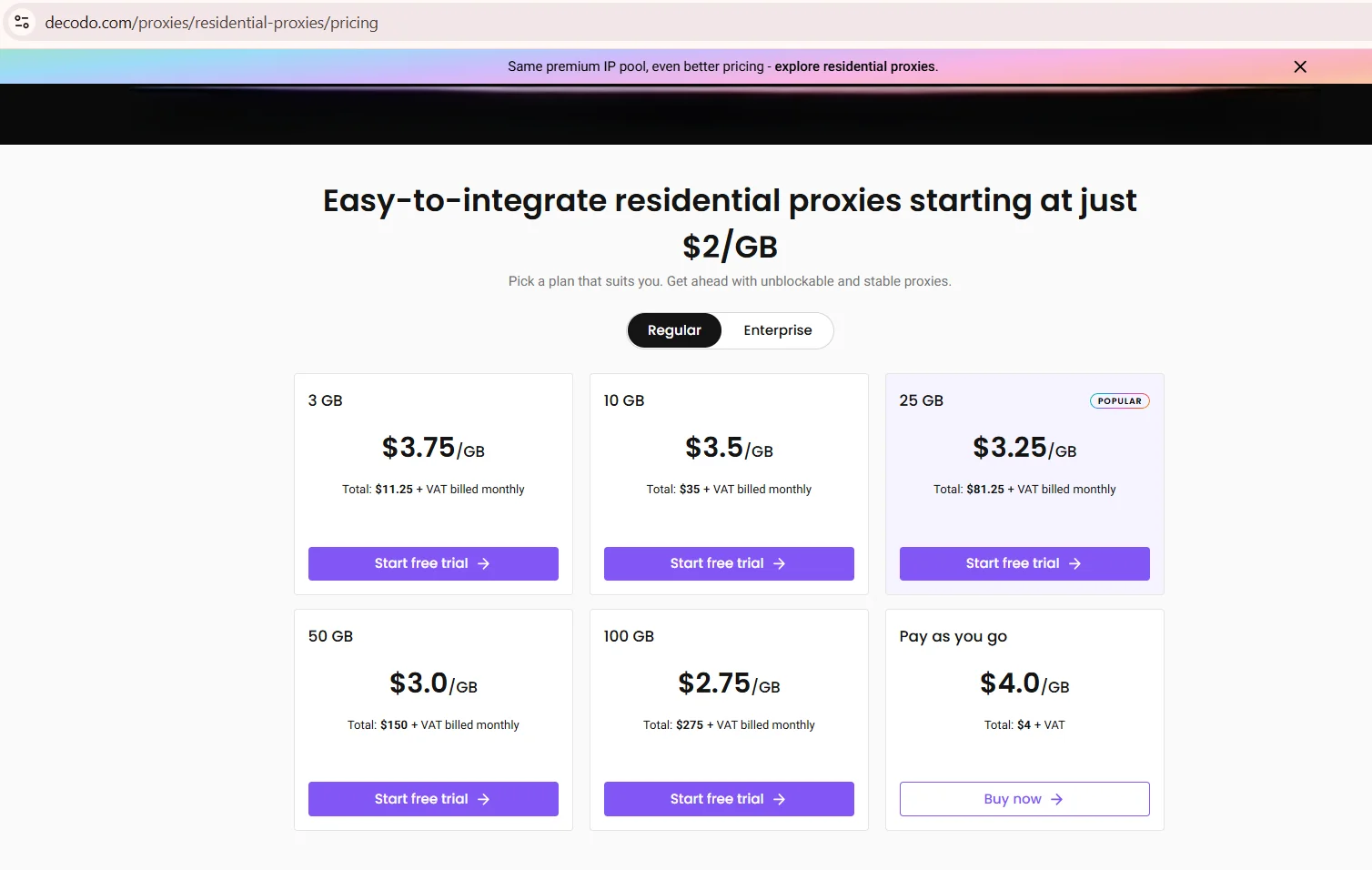
Source: Residential Proxies Pricing, Regular tab, decodo.com, screenshot taken August 2026
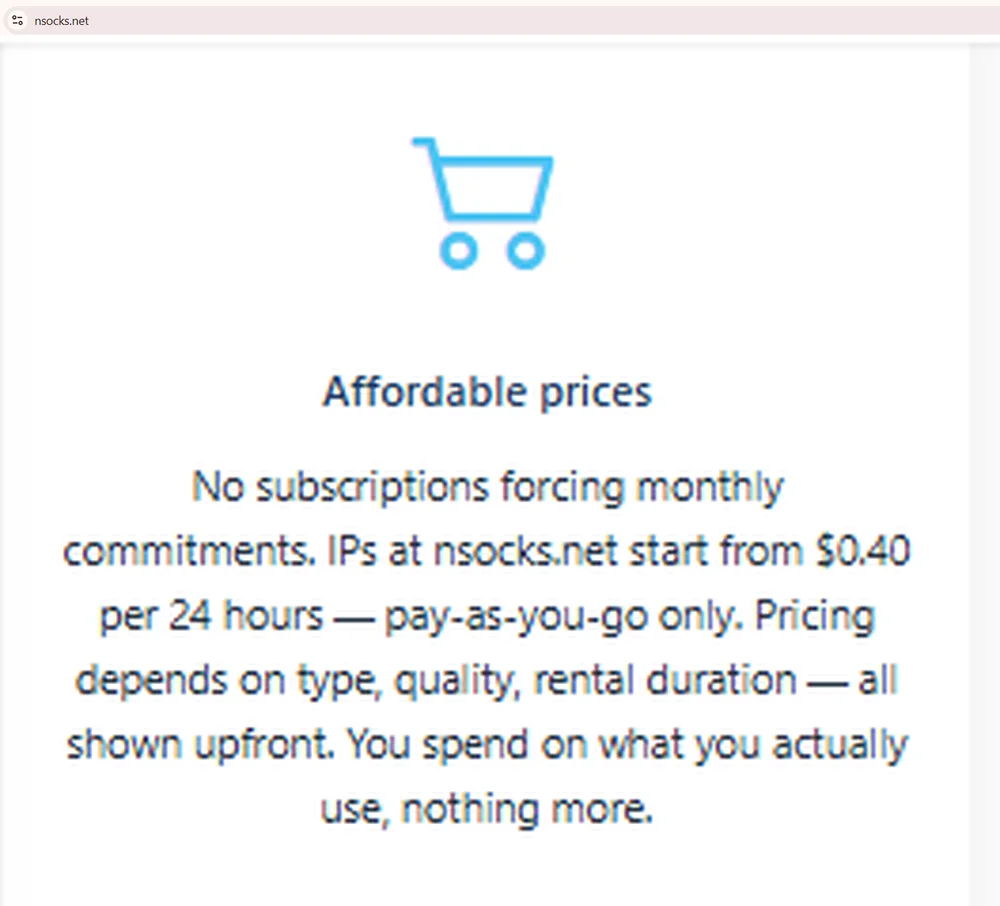
Source: Affordable prices block, nsocks.net, screenshot taken August 2026
| Provider | Advertised pool | Entry price per GB | Targeting |
|---|---|---|---|
| LunaProxy | 200M+ | $2.50/GB at 5 GB, $0.35/GB at 1 TB | City and country from 50 GB, ISP and ZIP from 200 GB |
| IPRoyal | 64M+ | $7.00/GB, $1.75/GB bulk | Country, state, city, ZIP |
| Oxylabs | 175M+ | $6.00/GB, $2.50/GB at 1TB | Country, state, city, ASN |
| Decodo | 115M+ | $3.75/GB, $2.75/GB at 100GB | Country, state, city, ASN |
| NSOCKS | Not published | Not applicable, billed per IP | Country, city, ZIP, ISP |
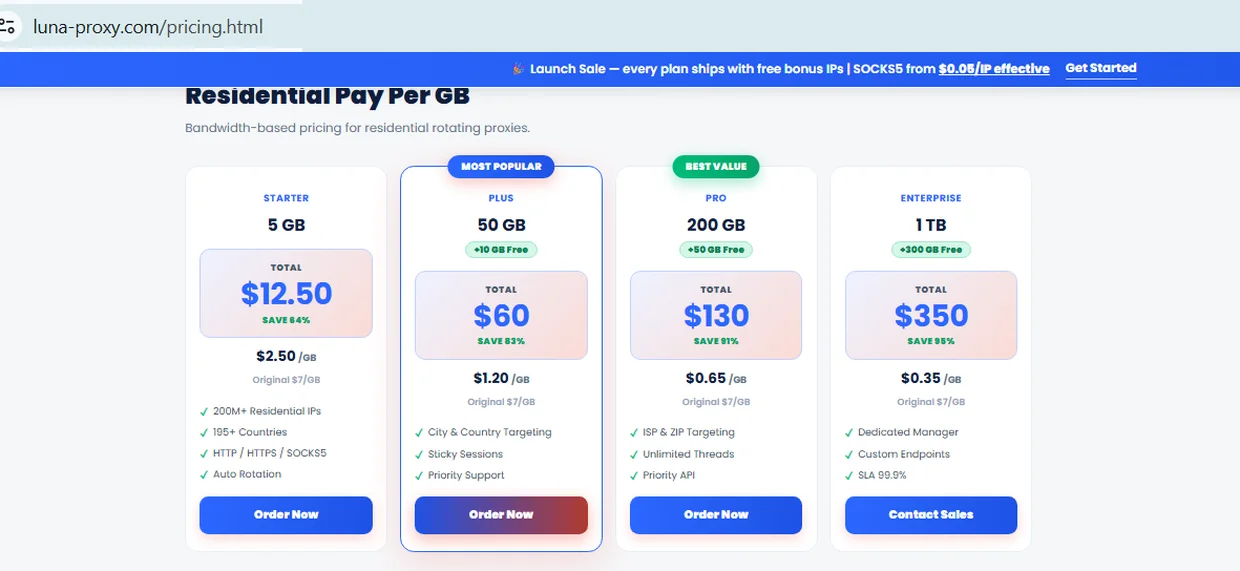
Source: Residential Pay Per GB, luna-proxy.com/pricing.html, screenshot taken August 2026
On the Pay Per GB tab the same pattern repeats: the entry plan is 5 GB for $12.50, which works out at $2.50 per GB against an original rate of $7 per GB, and the $0.35 per GB figure belongs to the 1 TB Enterprise plan. City and country targeting starts on the 50 GB plan, ISP and ZIP targeting on the 200 GB plan, and a 99.9 percent SLA is listed only at 1 TB.
Alternatives for static and ISP products
Static and ISP pricing separates LunaProxy competitors more clearly than residential, since fixed IPs bill per unit monthly, not by traffic. Oxylabs lists ISP proxies from $1.60/IP on the Starter tier, falling to $1.20/IP at 500 IPs, IPRoyal from $1.80/proxy, LunaProxy's Static ISP from $2.50/IP monthly on the 10 IP plan, falling to $1.20/IP at 200 IPs. Decodo's static tier starts lower, $0.27/IP, at bulk volume only. NSOCKS lists static and ISP lines, but no monthly rate was published here.
- ✅ Oxylabs ISP: from $1.60/IP at 10 IPs, $1.20/IP at 500, unlimited bandwidth under fair use
- ✅ IPRoyal ISP: from $1.80/proxy, SOCKS5 included
- ⚠️ LunaProxy Static ISP: $25/mo for 10 IPs, which is $2.50/IP, down to $1.20/IP at 200 IPs, US and EU addresses, 15+ country ISPs on the Pro tier
- ⚠️ Decodo static residential: from $0.27/IP at bulk volume only
- ❌ NSOCKS static/ISP: listed, monthly rate not published
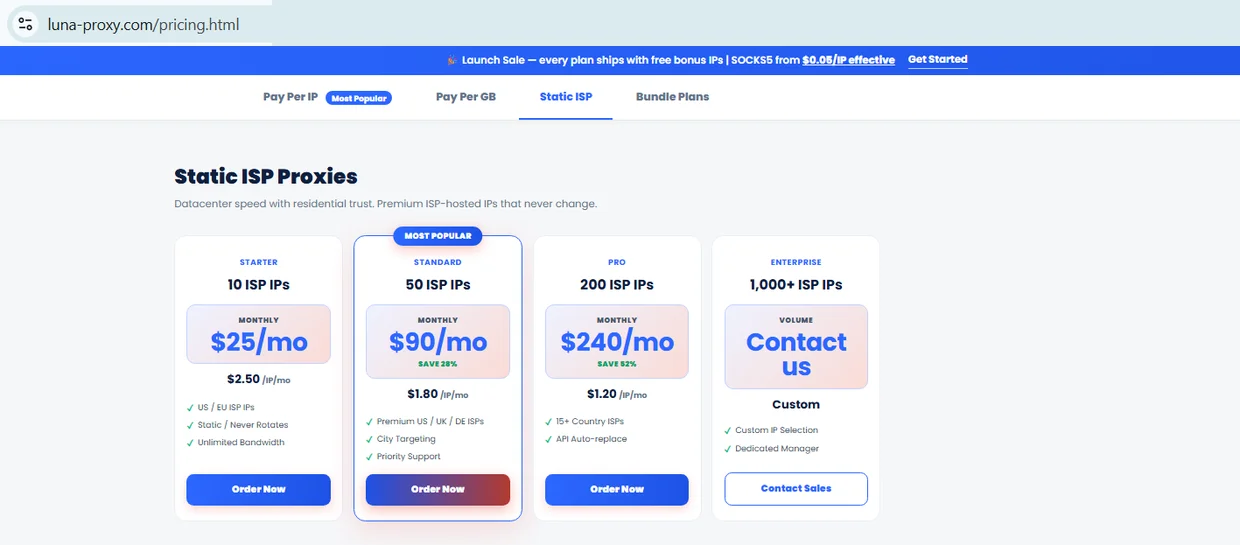
Source: Static ISP Proxies, luna-proxy.com/pricing.html, screenshot taken August 2026
LunaProxy also sells bundles that mix all three products in one purchase, starting at $89 for 500 SOCKS5 IPs with 20 GB of rotating traffic and 5 static ISP IPs, and running up to $799 for 10000 IPs with 500 GB and 100 static IPs. None of the other providers compared here packages the three lines together, which matters if a workload needs more than one type at once.
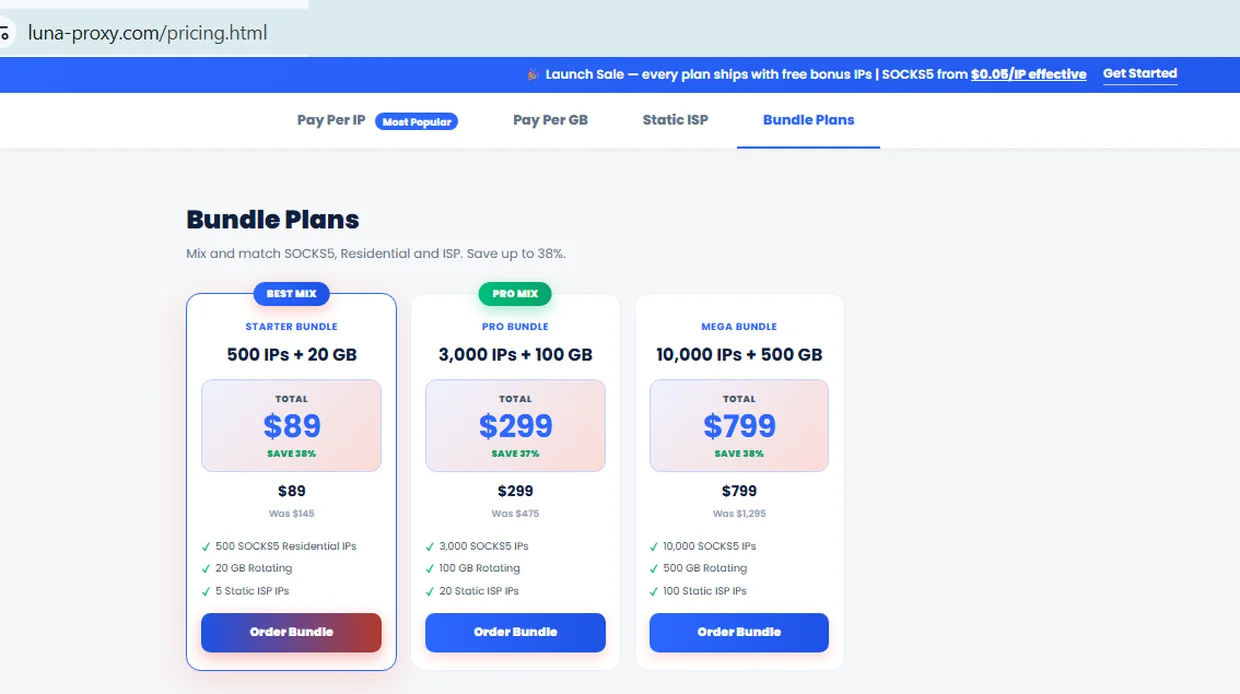
Source: Bundle Plans, luna-proxy.com/pricing.html, screenshot taken August 2026
Each of these numbers belongs to one specific LunaProxy alternative, not a blended average across providers.
Source: ISP Proxies Pricing, oxylabs.io, screenshot taken August 2026
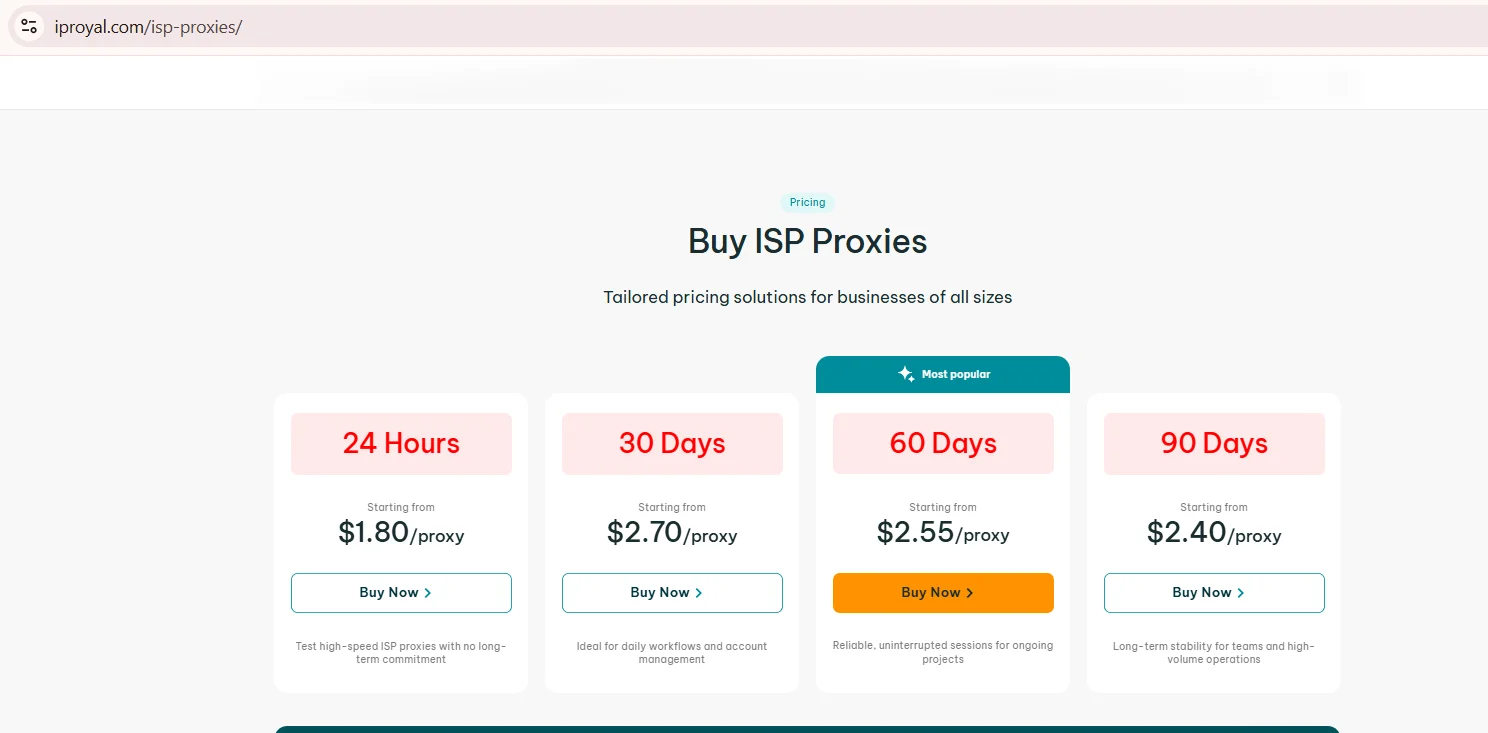
Source: Buy ISP Proxies, iproyal.com, screenshot taken August 2026
Protocol support: SOCKS5, HTTP(S) and UDP
Protocol support splits into three transport types worth checking before picking a provider. HTTP(S) cannot carry UDP traffic at all, while SOCKS5 can, at least at the protocol level. A fair LunaProxy review still has to confirm whether a given provider actually enables and documents that support. Remote DNS through the proxy, not locally, is worth checking first; it closes a common leak path.
LunaProxy, IPRoyal, Oxylabs, and Decodo all document SOCKS5 alongside HTTP(S) on their own pages, placing them among the SOCKS5 proxy providers worth a second look. NSOCKS documents SOCKS5 with remote DNS, built around dedicated per-IP access, not a shared pool.
Pricing models and how to compare across them
Billing across these LunaProxy alternatives falls into three groups: per GB, per IP, and per IP per month for a fixed address. None compares directly until converted into one monthly cost for the same workload.
| Billing model | Unit | What you pay for |
|---|---|---|
| Per GB | Gigabyte of traffic | Data through rotating IPs, no IP cap |
| Per IP | One IP address | A specific IP for a set window, no traffic cap |
| Per IP per month | One static IP | A fixed address for the full billing period |
How to compare across billing models: take a scenario, such as 20GB a month, or 10 sticky sessions running 8 hours a day, and price it on every tier. Marketing pages advertising cheap residential proxies rarely show this normalized number up front. A per-GB plan is simple math: multiply the rate by 20. Only after that conversion does a monthly figure mean anything across billing models.
How to migrate and test a new provider
Migrating away from Luna Proxy or any other provider rarely breaks anything, since most tools accept a standard host, port, username, and password format. The real risk is skipping the test phase and assuming a new pool behaves like the old one. A short test run catches block rates, latency spikes, and mismatched geo targeting before production depends on it.
- Sign up and request a small trial or minimum top-up on the new provider.
- Send at least 200 requests to the real target and record success rate.
- Log latency as p50 and p95, since a slow tail matters more than the median.
- Test sticky sessions at 10, 30, and 60 minutes to see how long an IP holds.
- Verify geo targeting against an independent IP geolocation service.
- Run both providers in parallel for a day before cutting over fully.
- Move credentials to staging first, then shift traffic.
Common mistakes when switching providers
Switching between LunaProxy competitors goes wrong more from process shortcuts than a bad IP pool. Teams under deadline pressure skip the parallel test window and cut over on day one. Others compare list prices without normalizing billing unit, then get surprised by the real bill.
- ❌ Switching all traffic at once instead of running old and new together
- ❌ Comparing sticker prices without converting to one billing unit
- ❌ Skipping the geo-check against an independent source
- ❌ Reusing retry logic tuned for the old pool
- ❌ Not documenting the new credential format before the team needs it
Mistakes like these surface in the first week, well before a full LunaProxy alternative cutover would.
Where NSOCKS fits
Disclosure: NSOCKS is our service. NSOCKS sells SOCKS5 access per IP per 24 hours, pay-as-you-go, no subscription, suited to teams that buy what they use, across residential, mobile, ISP, static and UDP lines. Every listed IP shows location, speed, and ISP first, the kind of detail a careful LunaProxy review would also check. Using NSOCKS proxies means confirming your use falls under applicable US law, for legitimate data collection and SEO monitoring.
| Feature | What it means in practice |
|---|---|
| Per-IP, pay-as-you-go billing | No subscription, spend only on IPs bought |
| SOCKS5 with remote DNS | DNS requests resolve through the proxy |
| Live IP list before purchase | Location, speed, and ISP visible before you pay |
| 2-hour refund window | Manual refund if an IP goes offline early |
NSOCKS sits among the LunaProxy alternatives that price per IP instead of per GB, closer to a boutique shop than a bulk pool operator.
Key takeaways
The comparison above boils down to a few points for anyone narrowing down LunaProxy alternatives. Pool size alone does not decide a winner, since targeting depth and protocol docs matter just as much. Price only becomes comparable once converted to the same billing unit. A short test window beats a leap of faith.
- ✅ Match the billing unit to your workload before comparing prices
- ✅ Check SOCKS5 and UDP documentation on the provider's own page
- ✅ Test at least 200 requests with p50 and p95 latency before switching
- ✅ Verify geo targeting with an independent IP lookup, not the vendor tool
- 💡 Keep the old provider running in parallel during the first test week
Disclosure and data sources
Every price and pool figure in this LunaProxy review links back to a live page, not a cached quote. This article is published by NSOCKS, one of the services listed, and we have a commercial interest in it. We are not affiliated with any other provider mentioned; none sponsored this article. Third-party data was taken from providers' own pages on Aug 19, 2026 and may be promotional. Trademarks belong to their owners, used for identification only.
Frequently asked questions
What types of LunaProxy alternatives exist?
Options split into rotating residential, static ISP, mobile, and per-IP SOCKS5, billed differently.
How do I compare providers with different billing units?
Convert every plan to one monthly cost for the same traffic pattern before comparing.
How do I verify a provider pricing claim?
Open the provider's own pricing page, screenshot it, and note the date beside the price.
Which providers document SOCKS5 with UDP support?
Check each provider's protocol page directly, since UDP support varies over time.
How much test traffic is enough to judge a provider?
Around 200 requests with p50 and p95 latency gives a fair first read.
Does switching providers require code changes?
Usually not, since most tools accept a standard host, port, username, password format.