IPRoyal alternatives: how to compare and choose
IPRoyal alternatives fall into three groups: pay-per-GB residential pools, per-IP static providers, and marketplace-style rental services.
This guide compares five of the best proxy providers with public pricing: IPRoyal, Decodo, Oxylabs, Bright Data, and NSOCKS, each documenting its own protocols in writing. Every figure carries a screenshot date, since price per GB rarely tells the whole story once billing units differ.
Legend used in every table below: ✅ documented by the vendor · ❌ not offered or not documented · ⚠️ documented with limits · 💡 practical tip. No other marks are used on this page.
IPRoyal alternatives compared
Selection criterion: each provider here lists a public price and documents protocols in its own docs, checked directly rather than assumed. Data as of August 2026.
IPRoyal alternatives differ mainly in billing model and pool size, not basic mechanics. Some bill strictly per GB, others mix per-GB and per-IP products in one lineup, which makes a quick "from $X" line misleading. The table lists the entry tier for residential proxies at each provider, from official pricing pages. Static residential and mobile proxies get a separate breakdown below.
| Provider | Protocols | Billing unit | Entry price (residential) | Pool size |
|---|---|---|---|---|
| IPRoyal | HTTP, HTTPS, SOCKS5 | per GB | $7.00/GB at 1 GB, subscription tab, 5% off applied | 64M+ IPs |
| Decodo | HTTP(S), SOCKS5 | per GB | $3.75/GB at 3 GB (list) | 115M+ IPs |
| Oxylabs | HTTP(S), SOCKS5 | per GB | $6.00/GB at 5 GB (list) | 175M+ IPs |
| Bright Data | HTTP(S), SOCKS5 | per GB | $8.00/GB list, $4.00 promo | 400M+ IPs |
| NSOCKS | HTTP, SOCKS5 | per GB / day | not published, dynamic | not published as a headline figure |
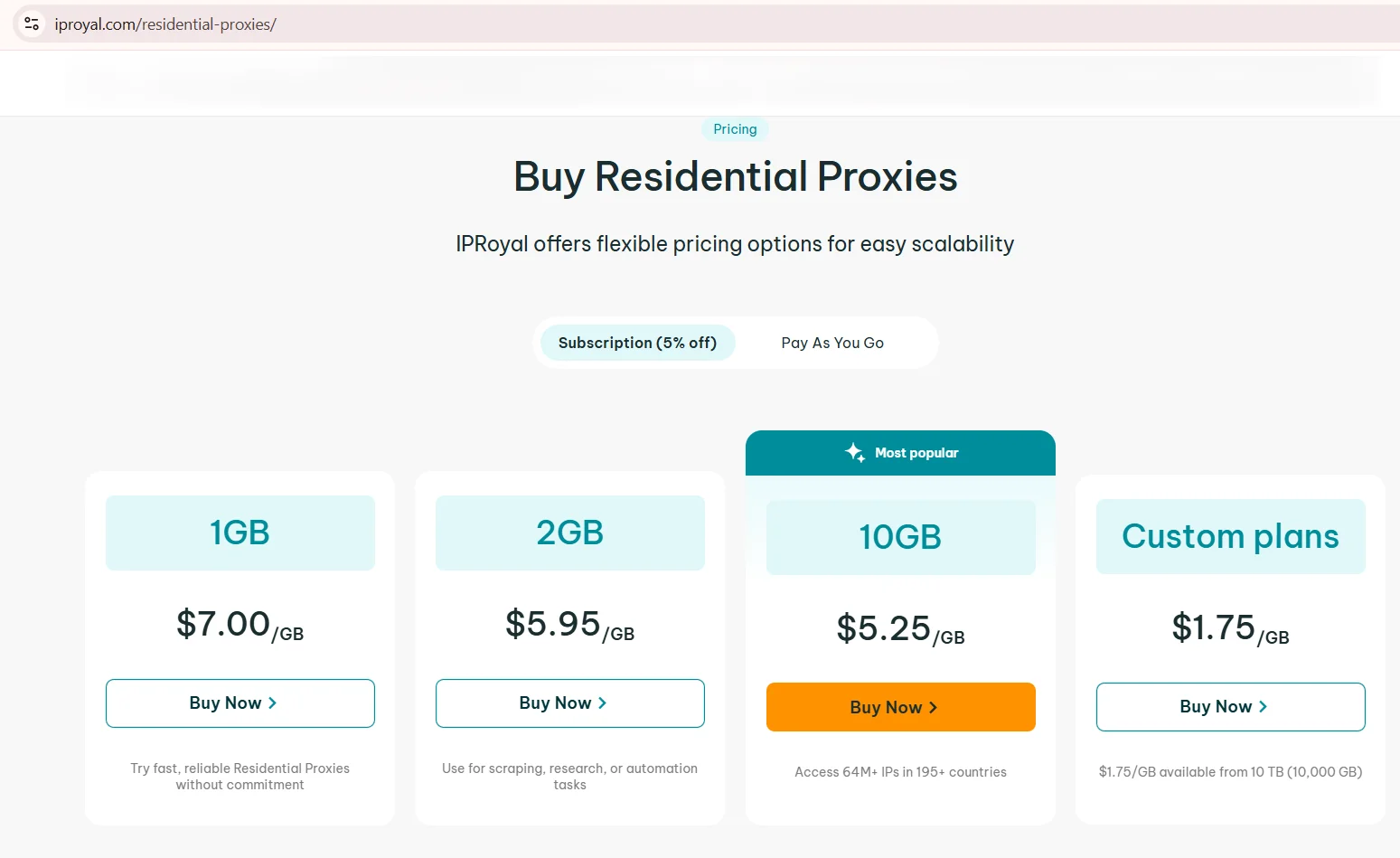
Source: Buy Residential Proxies, Subscription tab, iproyal.com, screenshot taken August 2026
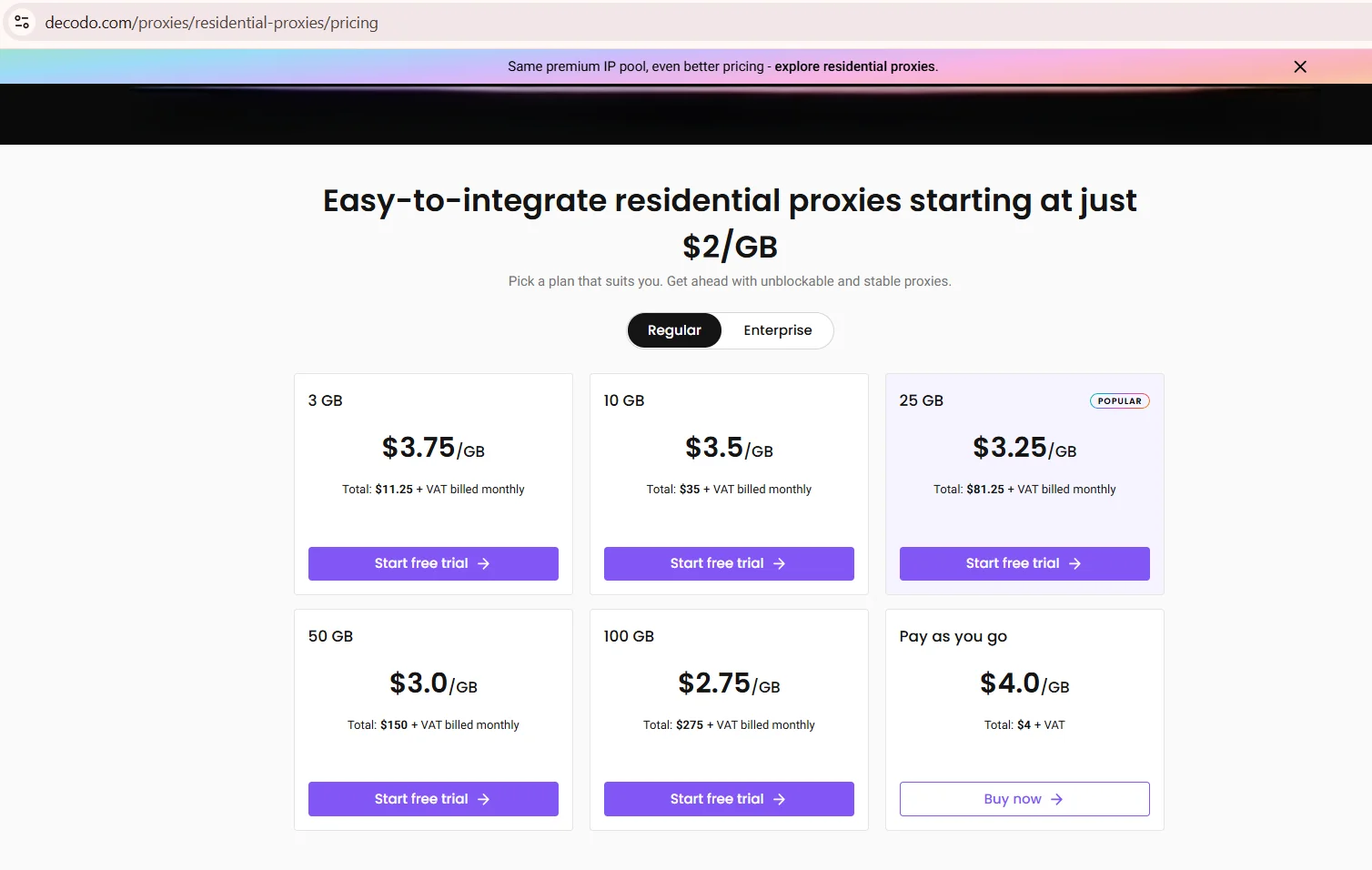
Source: Residential Proxies Pricing, Regular tab, decodo.com, screenshot taken August 2026
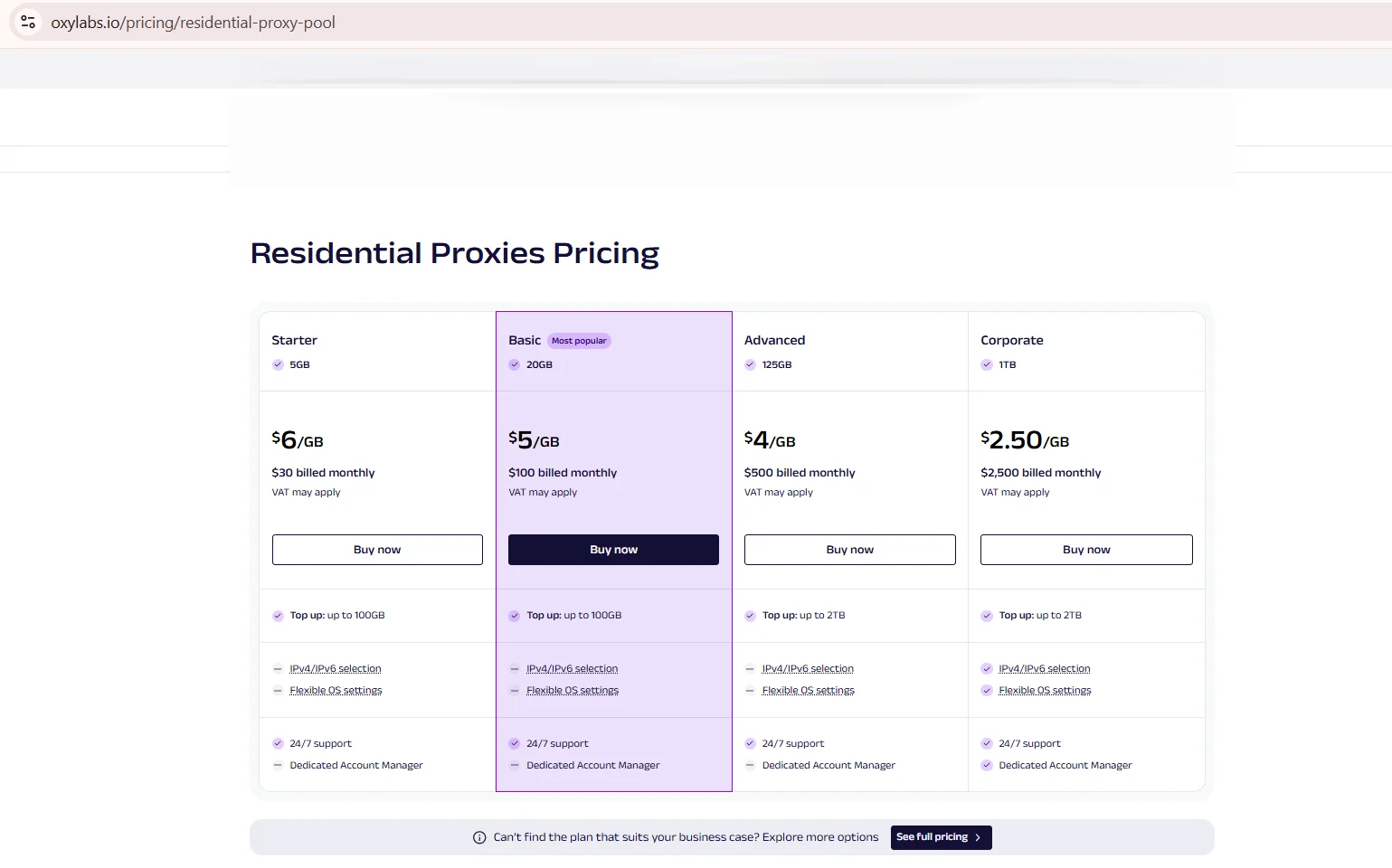
Source: Residential Proxies Pricing, oxylabs.io, screenshot taken August 2026
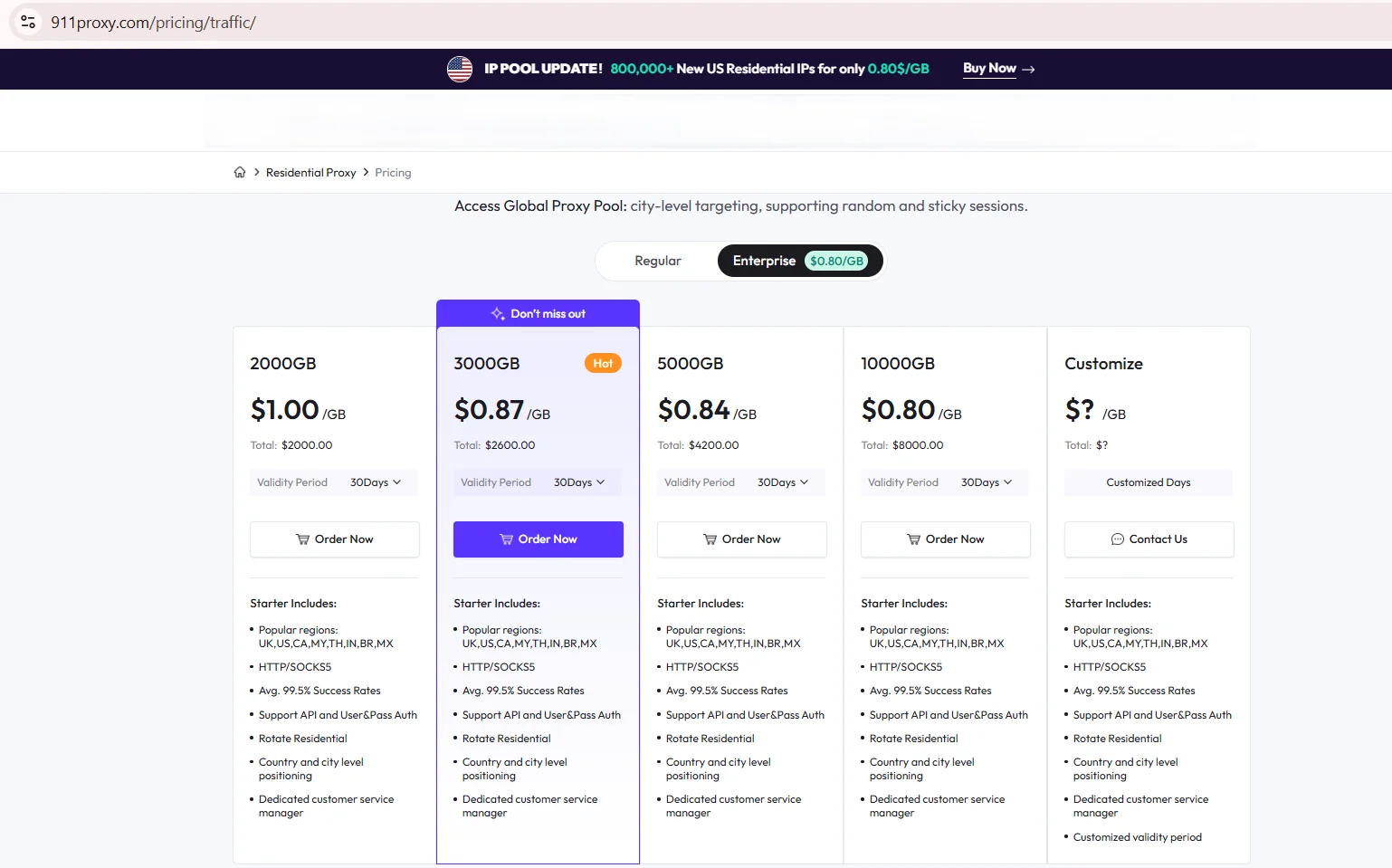
Source: Proxy Networks Pricing, residential tab, brightdata.com, screenshot taken August 2026
Treat this list of IPRoyal alternatives as a shortlist, not a final verdict; the sections below cover protocols, product categories, and a short test checklist before anyone commits budget.
Why teams look for an alternative and how this list was built
Switching is not always about price; sometimes one missing documented feature decides it. Teams look for an IPRoyal alternative when their billing unit does not match traffic patterns, or a target needs a protocol their plan lacks. These reasons come from documentation, not scattered complaints.
Common triggers: a shift from GB billing to a flat per-IP or per-day model, documented UDP inside SOCKS5, or city-level targeting a plan skips. None of this implies a gap in IPRoyal's own lineup: it documents residential, ISP, datacenter, and mobile products with SOCKS5.
- ✅ Documented UDP inside SOCKS5, if needed
- ✅ A billing unit matching your traffic pattern
- ✅ Pool size and coverage for your geo targets
Selection rule: a service counts as an IPRoyal alternative only if it publishes price per GB or IP on its own site.
Protocol support: SOCKS5, HTTP(S) and UDP
HTTP(S) cannot carry UDP at all. SOCKS5 can support UDP via the ASSOCIATE command, but only if a provider enables it. Remote DNS, often written SOCKS5h, stops DNS leaks that expose the real path.
Many pricing pages list "SOCKS5" without stating UDP status. That matters for any workload beyond plain HTTP, and it is a common blind spot among residential proxy providers, since two listings can say SOCKS5 and behave differently. Confirm UDP in writing before relying on it.
- ✅ documented: protocol and UDP status stated in official docs
- ❌ not documented: no mention of UDP or remote DNS
- ⚠️ documented with limits: UDP only on specific plans
Residential, ISP and datacenter products compared
Residential, ISP, and datacenter proxies use different IP sources, so one table row cannot fairly compare them. This section keeps residential against residential and ISP against ISP, so a look across IPRoyal competitors stays fair.
Residential IPs come from real household devices in a shared pool, hence the highest per-GB price. ISP proxies pair a residential-registered address with datacenter hosting for a static, residential-style IP. Datacenter proxies are cheapest and fastest; mobile proxies follow the same rule, compare mobile only against mobile. Naming varies among IPRoyal competitors, so the IP source matters more than the label.
| Category | Provider | Entry price |
|---|---|---|
| Residential | IPRoyal | $7.00/GB at 1 GB |
| Residential | Decodo | $3.75/GB at 3 GB |
| Residential | Oxylabs | $6.00/GB at 5 GB |
| ISP | Decodo | $0.27/IP, high volume |
| ISP | Oxylabs | $1.60/IP at 10 IPs, $1.20/IP at 500 |
Source: ISP Proxies Pricing, oxylabs.io, screenshot taken August 2026
Data as of August 2026.
Pricing models and how to compare across them
Billing across residential proxy providers falls into three units: per GB, per IP on a fixed term, and per day for unlimited-style plans. Comparing a per-GB price to a per-IP price without normalizing is not a real comparison.
| Model | Unit | What you pay for |
|---|---|---|
| Pay-as-you-go | GB | Bandwidth used |
| Subscription | GB tier | Fixed allowance, lower rate at scale |
| Static rental | IP / month | A dedicated address, set period |
| Unlimited-style | Day | Pool access, no GB cap |
How to compare across billing models: pick one scenario and price it for every provider instead of comparing raw sticker prices. A common baseline is 20 GB a month, or 10 sticky sessions at 8 hours a day; both turn any unit into one monthly figure. An IPRoyal alternative billed per IP can beat a per-GB plan once that scenario runs through both.
Anyone chasing cheap residential proxies should run this same math first, since sticker price alone rarely reflects the final bill.
- 💡 Normalize to one scenario before comparing prices
- 💡 Include add-ons like city or ASN targeting
- ❌ Comparing a "from" price against a different tier
How to migrate and run a fair provider test
A fair test runs at least 200 requests against a fixed target list, measures p50 and p95 latency, and checks sticky sessions at 10, 30, and 60 minutes. Notes from one session cannot support an IPRoyal review others might act on.
None of this needs expensive tooling, just a consistent process applied evenly to both providers being tested side by side. Migration and testing overlap: steps two and three double as the comparison test, run against the current and candidate provider. Keep the target list, count, and window identical, since a casual IPRoyal review from a few manual requests misses session drops or geo mismatches.
- Freeze scope: a target list, 200+ requests, fixed time window.
- Run both providers against that list, logging p50 and p95 apart.
- Test sticky sessions at 10, 30, and 60 minutes.
- Verify geo location with an independent IP service, not a dashboard.
- Move a small slice first, keep old credentials until confirmed.
Write up an internal IPRoyal review with numbers attached, so a teammate can repeat it later.
Common mistakes when comparing providers
The most common mistake is comparing a promo price to a list price, followed by mismatched volume tiers. Both are process mistakes.
- ❌ Promo price at one provider versus list price at another
- ❌ Reading "from $X" without the volume tier it applies to
- ❌ Trusting a dashboard's own geolocation over an independent checker
- ❌ Skipping UDP checks on SOCKS5 when a target requires it
- ❌ Ranking IPRoyal competitors on pool size alone, ignoring uptime
Where NSOCKS fits
Disclosure: NSOCKS is our service. The table below states what each feature means in practice, no claim of outperforming anyone on this list.
NSOCKS runs a residential pool across 190+ countries without publishing a headline size, plus static residential, ISP and mobile lines. Documented protocols are HTTP and SOCKS5, worth checking for any SOCKS5 proxies in this kind of provider comparison, with country, state, and city selection from the dashboard. IP whitelisting sits in the same panel, and uptime is listed at 99.95%. Exact price per GB is generated dynamically at checkout, so it is marked "not published" rather than estimated.
| Feature | What it means in practice |
|---|---|
| Residential pool across 190+ countries | Country, state and city selection; pool size not published as a headline figure |
| Country, state, city selection | Geo targeting from the dashboard |
| HTTP and SOCKS5 | Protocols documented on the product page |
| Long-acting ISP | A dedicated IP for a fixed period |
| 24/7 support | Chat-based support in the dashboard |
Using NSOCKS proxies means agreeing to use them within current United States law, for legitimate data collection, ad verification, and price monitoring. Anyone running the tests above can register, try a demo, or buy a plan.
Key takeaways
- ✅ Five IPRoyal alternatives compared: IPRoyal, Decodo, Oxylabs, Bright Data, NSOCKS
- ✅ Entry price per GB varies more than 2x across providers at the smallest tier
- ✅ SOCKS5 does not guarantee UDP, always check documentation first
- ✅ Normalize billing units to one monthly scenario before comparing prices
- 💡 Run a 200+ request test with p50/p95 latency before switching for good
Disclosure and data sources
This article is published by NSOCKS. NSOCKS is one of the services listed and we have a commercial interest in it. We are not affiliated with any other provider mentioned; none of them sponsored or reviewed this article. Third-party data was taken from the providers' own pages on August 19, 2026 and may be promotional. All trademarks belong to their respective owners and are used for identification only.
Frequently asked questions
The questions below cover what comes up most when comparing IPRoyal alternatives, kept short enough to scan fast.
What are the closest IPRoyal alternatives?
Closest matches split into three categories: per-GB pool providers, per-IP static providers, and marketplace-style per-IP rental services.
How do I verify a provider pricing claim?
Open the live pricing configurator, note the exact volume tier, screenshot it with a date, then confirm promo versus list price.
How do I compare providers with different billing units?
Convert every plan to one shared scenario, like 20 GB monthly, then compare the resulting dollar total, not the raw unit price.
Which providers document SOCKS5 with UDP support?
Check each provider's own documentation page; UDP under SOCKS5 is either stated there or noted as unavailable.
What test volume is enough to compare two providers?
At least 200 requests per provider against the same target list, with latency as p50 and p95, not a plain average.
Does changing providers affect my scripts?
Usually only the endpoint, port, and credentials change; HTTP and SOCKS5 integration code stays the same.