What is UDP proxy in 2026? Everything you need to know
A UDP-based route helps data move quickly when timing matters. Many users ask what is UDP proxy because modern apps, calls, media tools, and monitoring systems rely on fast packet exchange. In 2026, UDP remains important for tasks where low delay is more useful than heavy delivery confirmation. This technology can support stable transfer, lighter network load, and better connection control. It fits legal technical work, QA, diagnostics, and business monitoring. With nsocks, every setup is intended for lawful use in the USA and should follow platform rules.

What is UDP proxy and how does it work in 2026
In simple terms, what is UDP proxy means a routing layer that forwards UDP traffic between a client and a target service. It helps teams manage fast data flow without the overhead of permanent session checks. A UDP proxy server is useful when a workflow depends on quick response, low delay, and predictable routing.
| Area | UDP route | TCP route |
|---|---|---|
| Speed | Faster by design | More controlled |
| Reliability | No full delivery check | Delivery confirmed |
| Use cases | Live data flows | File transfer and pages |
| Latency | Usually lower | Usually higher |
This difference matters when a tool needs speed more than full confirmation. Still, setup quality, provider infrastructure, and local network conditions affect the final result.
How UDP protocol differs from TCP in proxy usage
A simple way to answer what is UDP proxy is to compare how UDP and TCP send data. TCP confirms packet delivery, while UDP sends packets faster and leaves some checks to the application. That makes UDP useful for live tasks where a delayed packet may be less valuable than the next fresh packet.
💡 Key idea:
- UDP focuses on speed
- TCP focuses on confirmation
- The best choice depends on the task
✅ Practical use:
- Calls
- Live media
- Game servers
- Monitoring tools
Core technical principles of UDP proxy routing
A UDP proxy forwards packets without creating the same permanent connection flow as TCP. It relies on packet forwarding, endpoint rules, and routing logic to move data quickly.
This is why it suits short, fast exchanges. The setup must still be tested, because a wrong port or protocol can break the workflow.
Why UDP proxies are important in modern networks
A UDP proxy server supports modern services where delay is visible: streaming, VoIP, real-time communication, and interactive systems. These workloads need short response times and consistent routes.
For business use, the value is practical. Teams can test media behavior, call stability, or app response under defined conditions.
Key benefits of UDP proxies
The main reason to learn what is UDP proxy is performance. UDP can reduce delay because it does not wait for the same delivery confirmation sequence as TCP. For the right use case, this means faster movement of small data packets.
High speed data transmission
A UDP proxy works well when the application can handle missing or late packets. This helps live tools keep moving instead of pausing for full recovery.
The benefit is not magic speed. It comes from lighter protocol behavior and better route planning.
Low latency for real-time applications
A UDP proxy server can help a support team test a voice tool used by US customers. The team checks call delay, short dropouts, and response stability during several sessions.
If results are consistent, the route can support the workflow. If not, the team reviews location, bandwidth, and local Wi-Fi.
Lightweight network communication
A UDP proxy can lower unnecessary control overhead for suitable tasks. This is useful when many small packets move quickly and the application manages quality at its own level.
💡 Optimization tips:
- Choose a close region
- Test at peak and quiet hours
- Monitor packet loss
- Keep one setup per task
Nsocks can be tested on a small workflow before scaling. Use to check whether the route fits your technical case.
Common use cases of UDP proxies in 2026

A practical answer to what is UDP proxy is easier through normal business scenarios. Legal examples include streaming checks, voice quality testing, game server monitoring, app diagnostics, and internal network review. The aim is stable measurement and clean reporting.
💡 Define the exact test before changing settings. A clear purpose makes reports cleaner.
Streaming and media delivery optimization
A UDP proxy may support streaming optimization when a team needs to check delay, buffering, and region-specific delivery quality. The process should be simple and repeatable.
- Select a lawful media test.
- Choose the target region.
- Start a clean session.
- Measure delay and buffering.
- Repeat during another time window.
✅ Useful checks:
- Start time
- Drop rate
- Audio sync
- Session duration
Online gaming and real-time interaction systems
Low latency connections matter in game servers, simulations, and interactive tools. Even small delays can affect timing, so teams often test routing, location, and connection load.
🎰 For interactive media systems, the task is technical: measure response, compare server regions, and document stability.
VoIP and communication platforms
For VoIP, stable packet flow is more important than large page loading speed. A support team may test a call platform from two US regions and record delay, jitter, and short audio gaps.
This case helps decide whether the current route fits customer support calls. It also gives engineers a clear issue log.
UDP proxy types and configurations
To understand what is UDP proxy in daily work, look at configuration types. Some routes keep one address, some rotate by rule, and some combine stable and flexible logic. network tunneling may also be part of technical setups when applications need structured transport.
| Type | Main behavior | Best fit |
|---|---|---|
| Static | Same address | Repeat testing |
| Rotating | Address changes | Wider sampling |
| Hybrid | Mixed logic | Complex workflows |
The right choice depends on the task. Start with the simplest setup that can be measured.
Static UDP proxies
Static routing keeps a predictable address. It is useful for repeated tests, monitoring dashboards, and controlled quality checks.
Rotating UDP proxies
Rotating routing changes addresses by rule, time, or session. This can help when a team needs broader sampling while keeping records clear.
Hybrid UDP proxy setups
Hybrid setups combine predictable and changing routes. They fit more complex workflows, but they require better documentation.
✅ Static style:
- Easier reports
- Stable comparison
- Good for monitoring
✅ Rotating style:
- Wider sampling
- Flexible checks
- Useful for diagnostics
❌ Limits:
- Hybrid needs planning
- Rotation may confuse reports
- Poor notes reduce value
How to choose a reliable UDP proxy provider
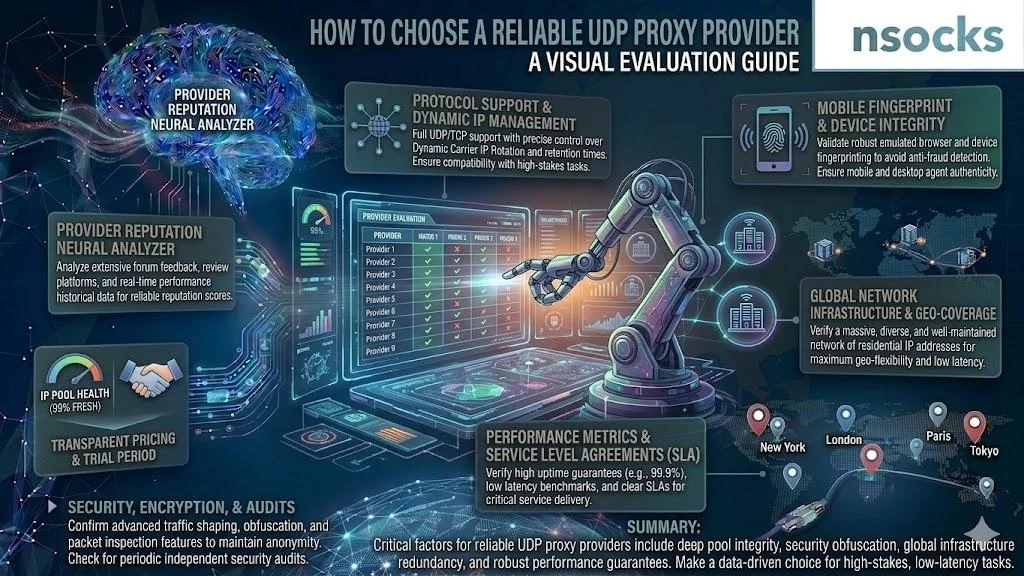
Choosing well starts with what is UDP proxy expected to solve for your team. For real-time tools, speed and delay matter most. For business checks, support, uptime, clear setup, SOCKS5 UDP support, and $ pricing also matter.
| Factor | Why it matters | What to check |
|---|---|---|
| Latency | Affects live tools | Test response |
| Uptime | Reduces gaps | Review stability |
| Coverage | Matches users | Check US regions |
| Setup | Saves time | Clear credentials |
| Support | Fixes errors | Fast replies |
Run one real test before buying a larger plan. A small verified workflow is better than unused capacity.
Speed and latency performance
A good technical decision should include testing. Check response time, packet loss, jitter, route location, and local Wi-Fi. One result is not enough for a final choice.
Infrastructure quality and uptime
Strong infrastructure reduces random drops and unstable results. Look for clear regions, reliable routing, and dashboard controls. Use when a small test confirms speed and stability.
Customer support and scalability
Good support is important because many setup issues come from one wrong value. 💡 Choose a provider with clear setup fields, fast replies, and simple scaling. Use when you need more regions, repeated tests, and team visibility.
Frequently asked questions
What is a UDP proxy in simple terms?
It routes fast packet-based traffic through a managed connection path.
How is UDP proxy different from TCP proxy?
UDP is faster and lighter, while TCP confirms delivery more carefully.
What are UDP proxies used for in 2026?
They are used for live media, calls, app tests, games, and monitoring.
Are UDP proxies faster than TCP proxies?
Often yes, because they use less delivery checking.
Do UDP proxies support real-time applications?
Yes, they can support voice, video, and interactive tools.