SOCKS5 vs HTTP proxy: key differences
SOCKS5 vs HTTP proxy is mainly about traffic type. HTTP proxies handle web requests, while SOCKS5 works at a lower network level and can support more applications, including non-web tools. The choice depends on speed, protocol needs, security setup, and legal workflow goals for US work today.
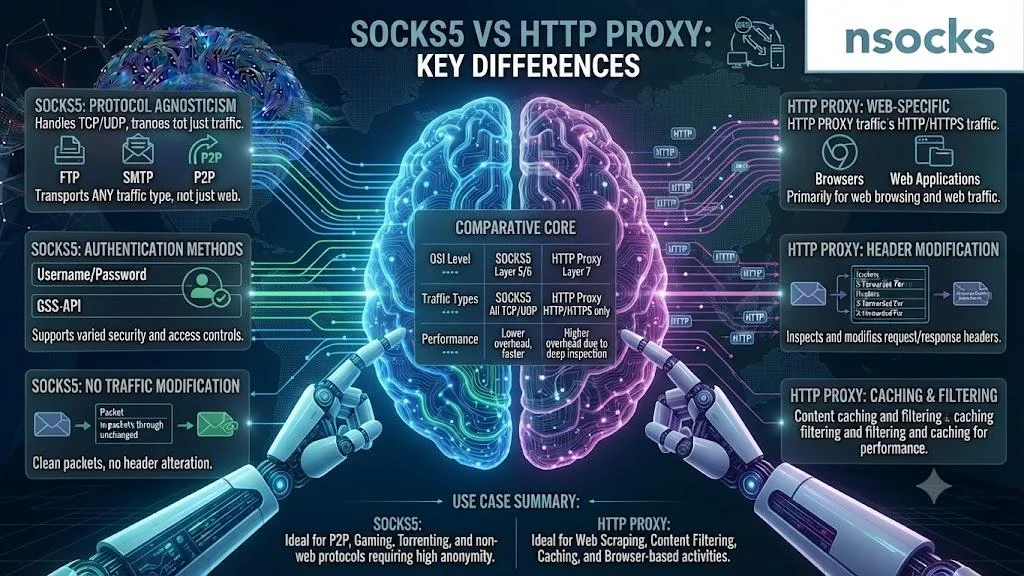
What is an HTTP proxy
An HTTP proxy routes browser-based web traffic between your device and a website. It is simple, familiar, and useful when the task is limited to web pages, SEO checks, or basic QA.
✅ Works well for:
- Web browsing tests
- Page checks
- SEO monitoring
- Simple request handling
❌ Not ideal for:
- Non-web apps
- UDP traffic
- Complex tool routing
For users comparing HTTP vs SOCKS5, this option is easier to start with but narrower in scope.
What is a SOCKS5 proxy
A SOCKS5 proxy routes traffic more flexibly because it does not focus only on web requests. It works with tools and apps that support proxy settings.
✅ Works well for:
- App-level routing
- Streaming checks
- Non-web tools
- Technical workflows
❌ Not ideal for:
- Users who only need basic web pages
- Teams without setup notes
- Tools that do not allow proxy settings
A SOCKS5 proxy is often more flexible than a basic web-only route.
SOCKS5 vs HTTP: side-by-side comparison
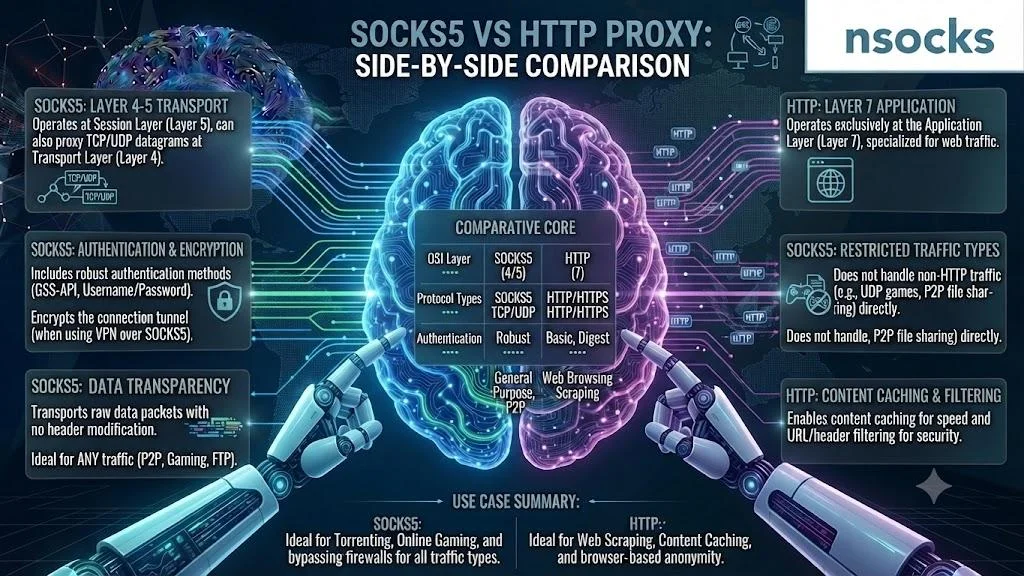
The short answer is simple: SOCKS5 vs HTTP proxy depends on whether you need only web traffic or broader application routing. HTTP is clean for web tasks, while SOCKS5 supports more protocols and app types. At the OSI layer view, SOCKS5 is broader, and TCP and UDP needs should be checked before setup.
| Criterion | HTTP route | SOCKS5 route |
|---|---|---|
| Network model | Web-focused | Broader routing |
| Transport handling | Usually TCP only | Can include both |
| Speed | Good for pages | Strong for apps |
| Applications | Browsers and web tools | Browsers, apps, tools |
| Authentication | Basic login options | Flexible login options |
| DNS | Often browser based | Depends on setup |
This comparison helps avoid overbuying. If one browser is enough, stay simple.
Speed and performance
SOCKS5 vs HTTP proxy performance depends on the task. HTTP may be fast for web pages, while SOCKS5 can be faster for lighter app routing.
- Step 1: choose one legal test task.
- Step 2: test page or app load time.
- Step 3: repeat with the second route.
- Step 4: compare notes before scaling.
Connection speed also depends on server distance, provider quality, and local Wi-Fi.
Security and encryption
The key point in HTTP vs SOCKS5 security is that neither type automatically guarantees full traffic encryption. Protection depends on protocol, app, HTTPS, and provider setup.
A proxy can support IP separation, but sensitive data still needs secure websites and credentials. For lawful US work, keep logins private and document the purpose.
UDP and streaming support
SOCKS5 vs HTTP proxy matters when a workflow needs UDP or non-web traffic. SOCKS5 may support UDP, while HTTP is mainly built around web request handling.
It fits streaming tests, media tools, and VoIP diagnostics. Nsocks users can review available protocol support before choosing a plan.
Application compatibility
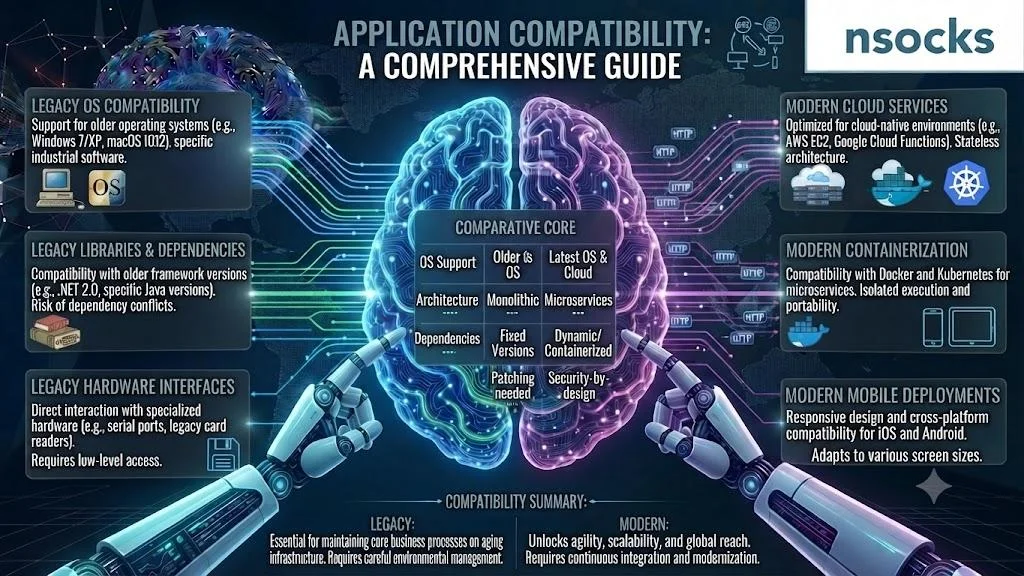
SOCKS5 proxy access usually fits more app types than HTTP access. HTTP works best with browsers and web tools, while SOCKS5 can serve software that needs broader routing.
Examples include browsers, API tools, desktop apps, monitoring, and media tools. Check app settings before buying.
When to choose SOCKS5
Choose SOCKS5 when SOCKS5 vs HTTP proxy points to broader compatibility, UDP needs, or non-web tools. It is better for workflows where browser-only routing is too limited.
Use it for:
- Streaming quality checks
- Non-web applications
- UDP-aware tools
- App monitoring
- Technical QA
Use it legally in the USA. Start small, then scale.
When an HTTP proxy is enough
HTTP is enough when the job is web-based and does not need advanced routing. In a basic HTTP vs SOCKS5 decision, choose HTTP for browser pages, SEO checks, and simple monitoring.
Use it for:
- Page QA
- Search checks
- Web analytics review
- Landing page testing
If work grows beyond web pages, move to a broader setup.
Common mistakes when choosing
❌ The most common mistake is choosing by price only. A cheap setup can cost more time if it lacks stability, clear DNS resolution, or proxy authentication.
| Mistake | Impact | Fix |
|---|---|---|
| Picking by price only | Unstable work | Test first |
| Ignoring app needs | Setup failure | Check compatibility |
| Skipping login review | Access errors | Verify credentials |
| Wrong location | Poor reports | Match US region |
A clear test plan prevents confusion. One task, one route, and one report format make results easier to compare.
Why SOCKS5 with UDP support is the better choice
For technical teams, SOCKS5 vs HTTP proxy often favors SOCKS5 when UDP, flexible apps, and broader routing matter. The benefit is not hype, but better fit for real workflows.
| Feature | Benefit |
|---|---|
| UDP option | Better real-time testing |
| App flexibility | More tool coverage |
| Login control | Cleaner access management |
| US locations | Better local checks |
| Clear dashboard | Easier team setup |
Try a small nsocks workflow, then buy proxies when speed and compatibility are proven. Register for full access if you need more profiles, locations, and team control in $ budgets.
Key takeaways
TL;DR for quick choice:
- HTTP is best for simple web tasks.
- SOCKS5 is better for apps, UDP, and broader routing.
- Speed depends on task, distance, setup, and provider quality.
- Legal US use requires clear purpose and platform compliance.
- Test one workflow before scaling.
Frequently asked questions
Is SOCKS5 faster than an HTTP proxy?
It can be faster for some apps, but speed depends on setup, distance, and provider quality.
Does SOCKS5 support UDP?
Yes, it can support UDP when the provider and application allow it.
Is SOCKS5 more secure than HTTP?
Not automatically. Security depends on encryption, website HTTPS, app behavior, and credential handling.
Can SOCKS5 handle any application?
No. It works only when the app supports that proxy type or can be configured for it.
Which is better for scraping, SOCKS5 or HTTP?
For legal scraping and monitoring, SOCKS5 is often more flexible, while HTTP can be enough for simple web pages.