Proxy vs VPN: which one do you actually need?
Proxy vs VPN is about scope and protection. A proxy routes selected traffic through another IP, often at application level. A VPN usually sends all device traffic through an encrypted system wide tunnel. For business tasks, the better choice depends on control, privacy, speed, and how much traffic you need to route.
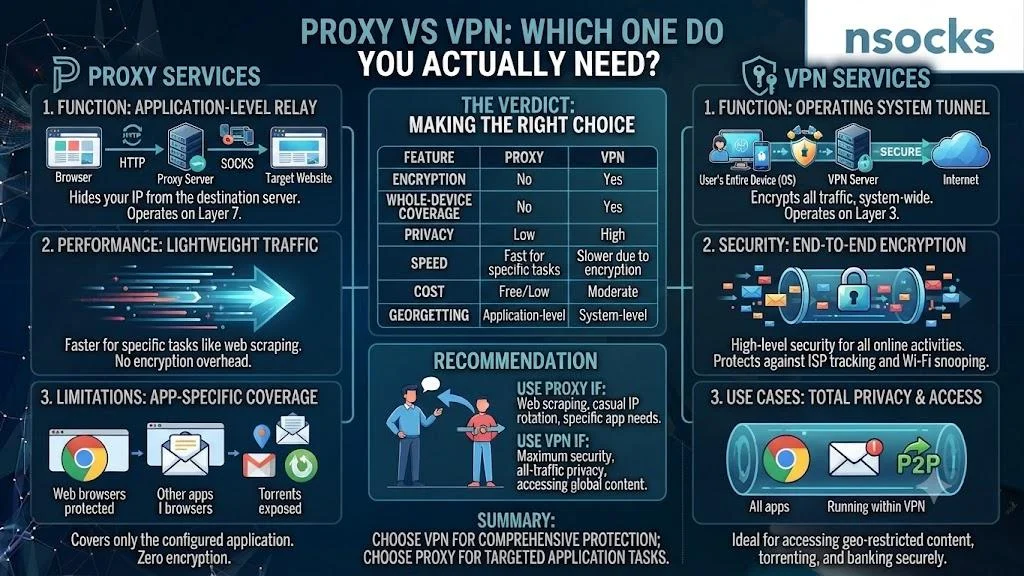
What is a proxy
A proxy is an intermediary server that sends selected requests through another IP address. The difference between proxy and VPN starts here: a proxy is more targeted and easier to assign to one browser, app, QA profile, or analytics tool.
✅ Good for:
- IP-based testing
- SEO monitoring
- App routing
- Localized page checks
❌ Not ideal for:
- Full-device protection
- Public Wi-Fi privacy
- Sensitive browsing
For legal US business use, proxies help with IP masking without routing the full device. Nsocks can separate work traffic from office connections.
What is a VPN
A VPN creates an encrypted tunnel between your device and a remote server. In a proxy vs VPN choice, VPNs are usually better when the whole device needs privacy.
✅ Good for:
- Whole-device coverage
- Travel browsing
- Wi-Fi privacy
❌ Not ideal for:
- App-specific control
- Large IP pools
- Regional testing
VPNs are simple for one person, but less flexible for teams that manage many locations or profiles.
Proxy vs VPN: side-by-side comparison
The difference between proxy and VPN is clearest when you compare scope, encryption, cost, and control. A proxy gives targeted routing, while a VPN usually gives broader protection.
| Criterion | Targeted route | Private tunnel |
|---|---|---|
| Encryption | Depends on setup | Usually included |
| Traffic coverage | App or browser | Whole device |
| Speed | Often faster | Can be slower |
| Control | More granular | More general |
| Cost | Flexible by plan | Usually subscription |
The best tool matches the workflow, budget in $, and legal use case.
Speed comparison
In many business workflows, proxy vs VPN speed favors proxies because they can route only selected traffic. VPNs may add overhead because all device traffic often passes through an encrypted tunnel.
Actual connection speed depends on distance, server load, protocol, and the target site. For SEO monitoring, QA, or public data review, a proxy can be faster because it is narrower.
- Step 1: choose one test page.
- Step 2: measure normal load time.
- Step 3: test the routed profile.
- Step 4: repeat later.
Encryption and security
The difference between proxy and VPN is important for protection. A VPN usually includes traffic encryption by default, while a proxy may or may not encrypt traffic depending on protocol and setup.
That does not make proxies unsafe. Use them for testing, analytics, monitoring, API work, and controlled business routing.
Coverage: app-level vs system-wide
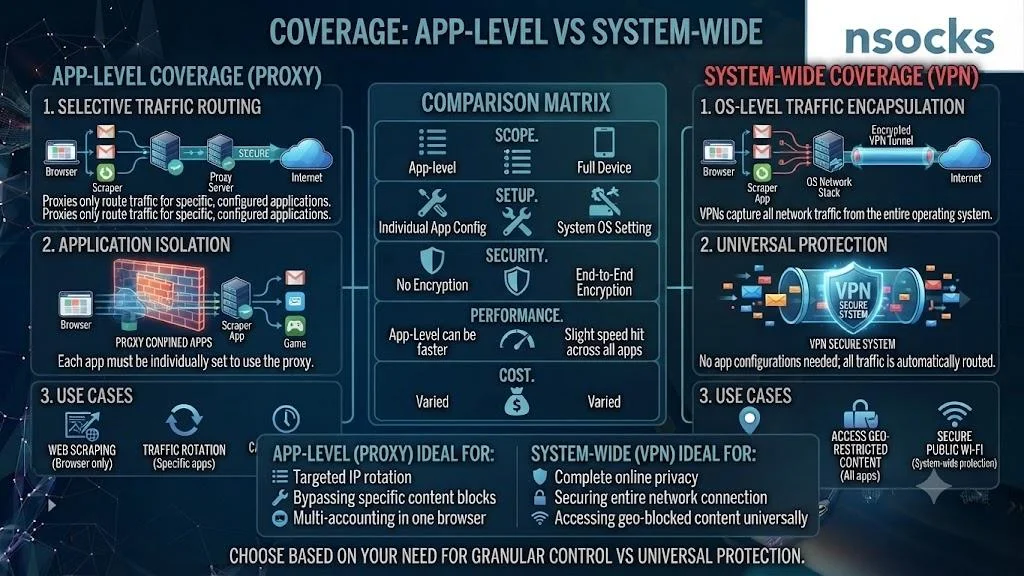
The proxy vs VPN decision often comes down to coverage. A proxy can work inside one browser or app, while a VPN usually covers the whole device after connection.
A marketer may route one browser profile, while a developer keeps other tools on the normal network.
When to use a proxy
Choose proxy or VPN based on task scope. A proxy is better when you need controlled routing for one app, browser, or workflow.
Use a proxy for:
- SEO rank checks
- Market research
- Ad verification
- QA testing
- API monitoring
Use it legally and document the business purpose. Test one workflow first, then scale if the setup is stable.
When to use a VPN
Choose VPN or proxy carefully when privacy is the main concern. A VPN is usually better for whole-device protection, travel browsing, and shared networks.
Use a VPN for:
- Public Wi-Fi browsing
- Personal privacy
- Device-wide routing
A VPN is not always the best fit for team analytics or many regional checks. For profiles, locations, and app control, a proxy setup is cleaner.
Common misconceptions
The difference between proxy and VPN is often simplified too much. Both tools route traffic, but they solve different problems.
| Myth | Reality |
|---|---|
| They are the same | They work at different scope levels |
| One is always safer | Safety depends on setup and task |
| Faster always means better | Stability matters too |
The wrong choice usually comes from an unclear task. Define the job first, then choose the route.
- ❌ Mistake: choosing a tool without defining the job.
- ❌ Mistake: mixing personal browsing with business testing.
Can you use both together
Yes, proxy vs VPN is not always an either-or choice. Some advanced workflows combine both, but this can reduce speed and complicate troubleshooting.
Use both only when there is a clear reason. For most business tasks, start with the simpler setup.
How to choose the right proxy for your needs
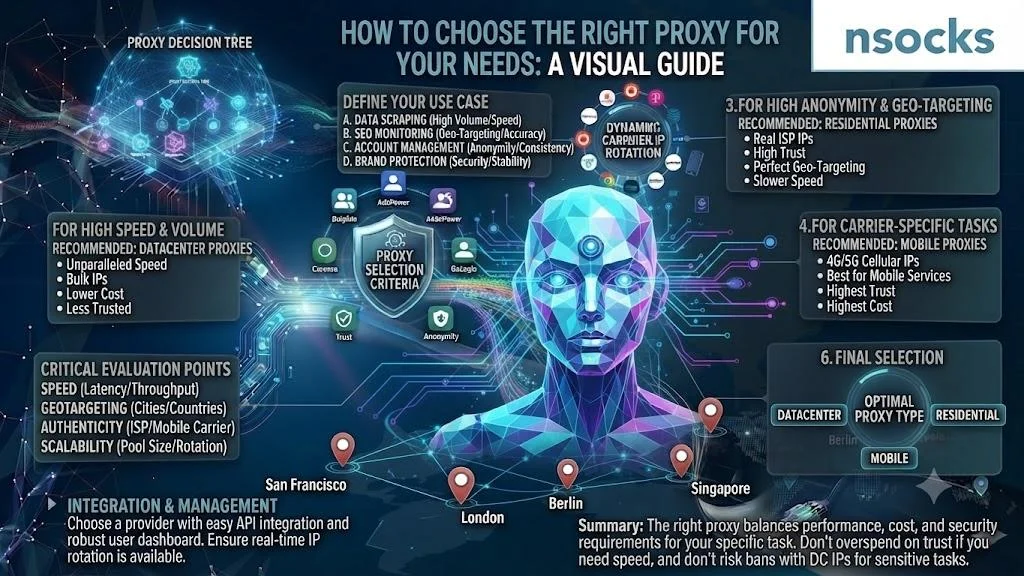
For business users comparing proxy vs VPN, the right proxy should match task type, location, speed, session length, and support needs. Nsocks is practical for clear setup and lawful use in the USA.
| Feature | Benefit |
|---|---|
| US locations | Local checks and $ pricing review |
| Stable sessions | Cleaner monitoring reports |
| Protocol choice | Better tool compatibility |
| Dashboard access | Easier team control |
| Support | Faster issue handling |
Start with one real workflow and measure the result. If stable, move to a larger setup. Register for full access when task, region, and budget are clear.
Key takeaways
TL;DR for quick choice:
- A proxy gives targeted routing for apps, browsers, and tools.
- A VPN gives broader device-wide protection.
- Proxies are often better for QA, SEO, monitoring, and analytics.
- VPNs are usually better for public Wi-Fi and whole-device security.
Frequently asked questions
Is a proxy the same as a VPN?
No. One usually routes selected traffic, while the other often routes all device traffic.
Which is faster, a proxy or a VPN?
A targeted route is often faster because it handles less traffic. Speed depends on server quality, distance, and load.
Does a proxy encrypt my traffic?
Not always. Encryption depends on protocol, setup, and the service used.
Can I use a proxy and a VPN together?
Yes, but it can reduce speed and make errors harder to diagnose. Use both only for a clear technical reason.
Which is better for web scraping, a proxy or a VPN?
A proxy is usually more practical for legal scraping and monitoring because it gives better control over profiles and locations.