🔍 Proxy score vs proxy checker: what's the difference
The quality of your proxies directly affects connection stability, service speed and how well your network operations perform. Businesses and individual users in the US rely on different tools to measure that quality, and two of the most common are proxy checker utilities and IP scoring systems. Most people treat them as the same thing, though they solve different problems. Each method answers a different question about your IP, and picking the wrong one wastes time. Wrong decisions here can snowball into failed requests, blocked accounts and lost revenue. Knowing which tool fits your situation matters when building a reliable proxy setup.
🧮 What is proxy score and how it works
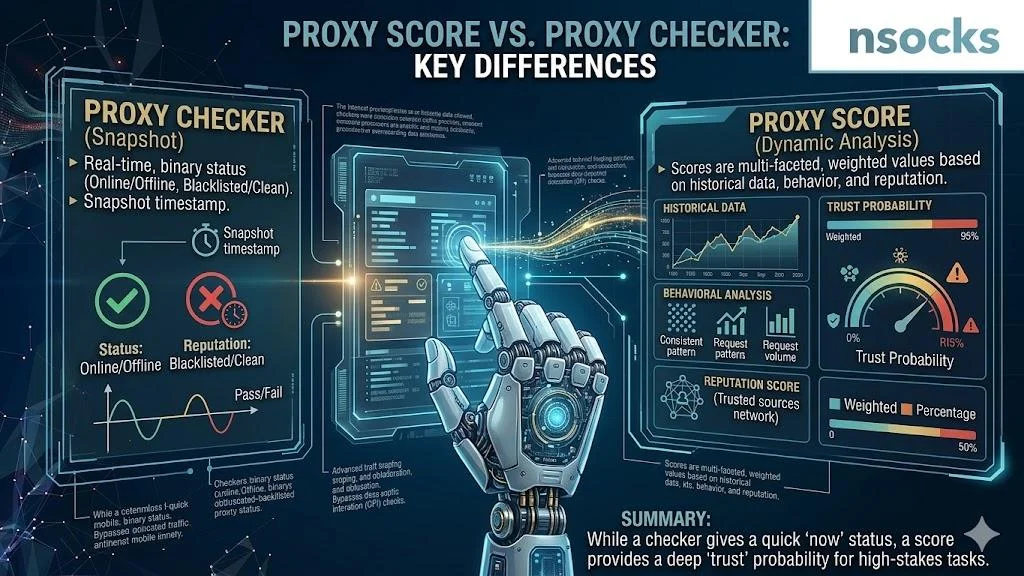
Proxy score is a rating system. It assigns a number to each IP based on several quality signals at once, like a credit rating for proxies. Automated platforms depend on these numbers to make routing decisions across thousands of connections. The concept gained traction as IP networks grew larger and manual evaluation became impractical. Today, most enterprise-grade providers include some form of scoring in their dashboards.
📖 Definition of proxy score in modern systems
This metric is a calculated value on a 0–100 scale showing how reliable a given IP is. Modern ip scoring algorithms pull from reputation databases, latency logs and usage history. An IP scoring 85+ typically has no blacklist flags and solid uptime. Below 40, expect blocks or flagged behavior. Some providers use a 0–10 or letter-grade scale instead, but the logic stays the same. Unlike a proxy checker that gives you a binary alive-or-dead result, the score condenses multiple data points into one readable metric that both humans and machines can act on quickly.
📊 Key factors that influence proxy score
Several variables feed into the final calculation. Weight distribution differs between scoring models, but most tools track the same signals. Even a quick run through an online proxy checker won't reveal these deeper layers. Understanding these factors helps you interpret results correctly and adjust settings when needed.
| Factor | What it measures | Impact on score |
|---|---|---|
| 🕐 Latency | Response time in ms | High latency drags score down |
| 🛡️ IP reputation | Blacklist presence | Flagged IPs lose major points |
| 📜 Usage history | Past activity patterns | Abuse history means penalties |
| 🌐 Geo-accuracy | Real vs declared location | Mismatch lowers trust |
| ⏱️ Uptime | Stability over time | Drops reduce the rating |
💡 How proxy score is used in practice
Ad verification platforms filter suspicious IPs through scoring before campaigns. Price comparison engines pick proxies with the best success rates in target regions. Data collection pipelines feed scores into rotation logic, IPs below a threshold get pulled automatically. SEO monitoring tools also rely on scoring to select region-specific IPs with clean reputations. A proxy checker alone can't make these decisions because it lacks the historical depth. In each case the goal is the same: let the system pick winners without human input slowing things down.
💡 Why scoring models matter for automation: Systems running thousands of requests per minute can't rely on manual checks. Scoring gives machines a way to pick the best IPs on the fly, fewer failures, lower costs.
🔧 What is a proxy checker and its main purpose
A proxy checker tests whether a specific IP works right now. It sends a request, measures what comes back and gives you a pass or fail. Where scoring looks at the big picture over time, this tool delivers a snapshot. That speed is exactly why so many people reach for it first. For quick list cleanup or pre-deployment validation, nothing beats the simplicity of a real-time check.
⚙️ Basic functionality of proxy checkers
The process is straightforward. The tool connects to the target IP, fires off a test request and records the result. A web-based version does this through a browser, no downloads, no setup. A socks5 proxy checker goes deeper and validates SOCKS5 handshake completion specifically. Green means alive, red means dead, yellow means slow. Most tools also display the detected country and ISP, which helps confirm geo-location accuracy before you route traffic through that IP.
📋 Types of checks performed by proxy tools
Standard proxy verification services run a defined set of tests. Not every proxy checker covers all of these, but most paid options do. The depth of testing depends on whether you're using a basic or professional-grade solution.
| Check type | What it tests | Output |
|---|---|---|
| 🔌 Connectivity | Can the proxy accept connections? | ✅ Active / ❌ Dead |
| ⚡ Speed | Response time under load | Latency in ms |
| 🕶️ Anonymity | Does it hide your real IP? | Transparent / Anonymous / Elite |
| 📍 Geo-location | Where the IP appears to be | Country, city, ISP |
| 🚫 Blacklist status | Is the IP flagged? | Listed / Clean |
A basic no-cost tool usually handles connectivity and speed. Paid versions add anonymity detection plus blacklist scanning. When you're working with large lists, a bulk proxy checker processes hundreds of IPs in parallel and saves hours of manual work. Some advanced tools even export results as CSV or JSON, making it easy to feed data into your own automation scripts.
❌ Limitations of proxy checker tools
Checkers are fast. They're also shallow. A single test gives you one data point from one location at one moment. Keep these gaps in mind before relying on one alone.
- ❌ No historical data - can't reveal past abuse or usage patterns
- ❌ No predictions - passing right now says nothing about tomorrow
- ❌ Context-dependent - results shift based on server location and time of day
- ❌ No ranking - you get binary output, not a quality comparison
- ❌ Protocol gaps - an http proxy checker won't flag SOCKS5-specific problems
⚖️ Proxy score vs proxy checker: key differences
One answers "does this IP work right now?" The other answers "how good is this IP overall?" Both matter. Understanding how to test a proxy properly starts with knowing which question you're actually asking. Mixing up these two approaches leads to wasted resources. You end up either over-testing working IPs or trusting bad ones based on outdated data.
| Criteria | Scoring | Checker |
|---|---|---|
| 🎯 Purpose | Rate overall IP quality | Test real-time status |
| 🔬 Depth | Multi-factor, historical | Snapshot at one moment |
| 📂 Data sources | Reputation DBs, usage logs | Live connection test |
| 🎯 Accuracy | Statistical, aggregated | Binary pass/fail |
| 🏢 Best for | Automated routing, risk filtering | List cleanup, quick diagnostics |
Running a proxy checker on 10,000 IPs tells you which are alive. Running those same IPs through scoring tells you which are actually worth keeping. Most professional setups in the US run both stages back-to-back before deploying a single request through their pool.
💡 When to use each: Check before deployment to kill dead IPs. Score after deployment to track trends and optimize. Both plug into a solid quality assessment systems workflow.
🔗 How proxy scoring and checking work together
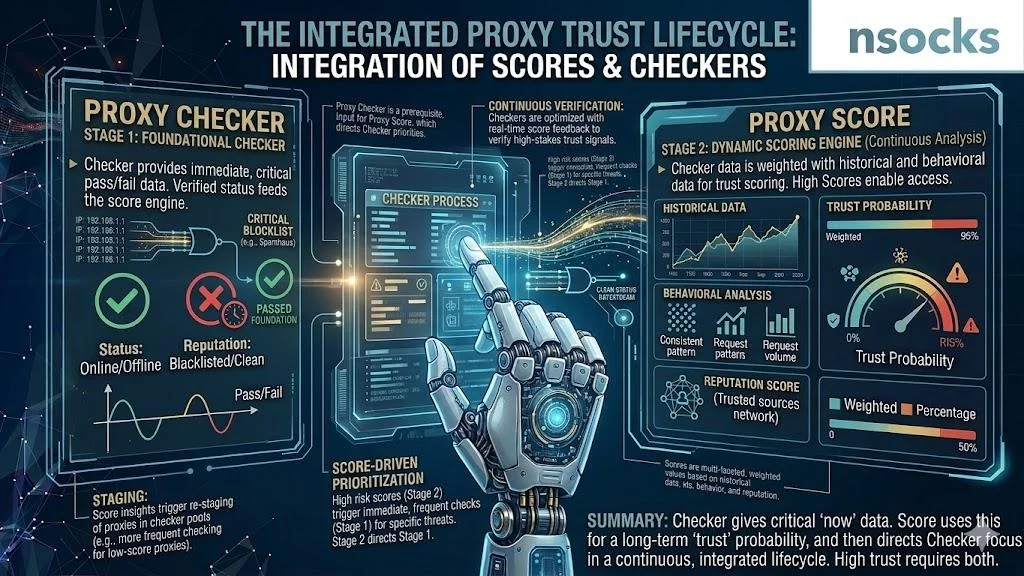
Neither method replaces the other. The smart move is stacking both into one pipeline, checks handle the first pass, scoring handles ongoing quality control. Even a free proxy checker can serve as that initial filter before heavier analysis kicks in. This layered approach is standard practice for teams that manage more than a few hundred IPs at a time.
🔄 Combined workflow in proxy evaluation
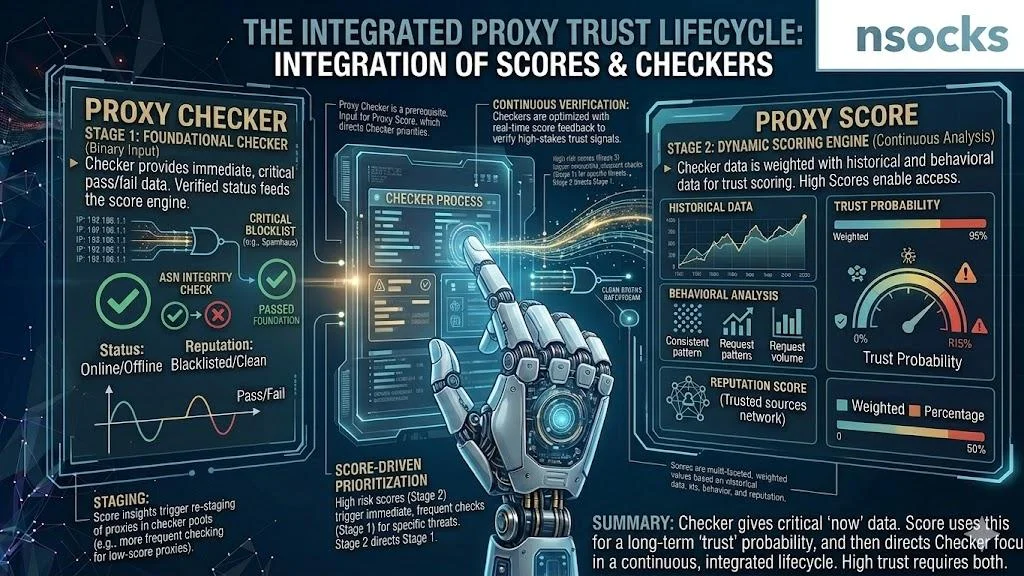
Most organizations run a proxy checker first to weed out dead connections. IPs that survive move to scoring for ranking on reputation, latency and history. This two-step setup saves processing power and produces a cleaner pool. Performance testing proxies through both stages catches problems that either tool misses alone. Teams that skip the first stage end up wasting scoring resources on IPs that were already dead.
🧱 Importance of multi-layer proxy validation
An IP can pass a live test and still carry a terrible reputation. A high-scoring IP might hit a temporary outage that only a real-time proxy checker would catch. One layer is never enough. The most reliable setups treat validation as a continuous loop, not a one-time gate.
- Import proxy list - load IPs from your provider
- Run connectivity check - drop dead IPs
- Test protocol support - verify HTTP, HTTPS and SOCKS5
- Apply scoring - rate surviving IPs on reputation, latency, history
- Set thresholds - define minimum acceptable scores
- Deploy top tier - route traffic through highest-rated proxies
- Monitor continuously - re-check and re-score at set intervals
Nsocks users get pre-scored pools, but layering your own checking tool on top adds full control. Register for access to test this with live data.
🏗️ Use cases of proxy score and checker in real systems
Both tools land in different industries. The trick is matching the right method to the right task. Below are three common scenarios where US-based teams put scoring and a proxy checker to work daily.
📊 Data collection and analytics systems
Scraping operations burn through IPs fast. Target sites rotate their defenses nonstop. A proxy checker flags which IPs got blocked after each crawl. Scoring predicts which ones will survive the next session. Without this combination, teams end up re-buying IPs they could have filtered out earlier. The cost adds up fast when you're running thousands of requests per hour.
🖥️ Network monitoring and infrastructure tools
IT teams managing distributed networks use connection analysis tools to monitor IP health across regions. A proxy checker triggers alerts on dropped connections in real time. Scoring feeds dashboards showing long-term quality shifts. When a provider's IP pool degrades over weeks, scoring data makes the trend visible before it causes downtime.
🚀 Performance optimization pipelines
Ad tech companies, price aggregators and SEO platforms need fast, stable connections. Scoring picks the fastest IPs from your pool. Running a proxy checker right before each batch confirms they're still operational. Milliseconds matter in these workflows, an IP that tested fine an hour ago might be throttled or blocked by the time your next job starts.
| Use case | Primary tool | Supporting tool | Goal |
|---|---|---|---|
| 🕷️ Web scraping | Connectivity tester | Scoring | Maximize success rate |
| 📈 SEO monitoring | Scoring | Verification tool | Geo-accurate, stable IPs |
| 🛡️ Ad verification | Scoring | IP tester | Filter suspicious traffic |
| 💰 Price comparison | Scoring | Live check | Region-specific access |
📝 Case study: A US-based e-commerce firm processed 2 million product pages daily. Running only live checks, they saw 18% failure rates. After adding scoring from proxy testing platforms, failure dropped to 4.2% in two weeks, saving $3,200/month.
✅❌ Advantages and limitations of both approaches
No tool does everything. A proxy checker and a scoring system each shine in different areas. Picking the right approach depends on your budget, scale and how much visibility you need into IP quality.
✅ Proxy score advantages:
- ✅ Multi-dimensional quality assessment
- ✅ Historical trend analysis
- ✅ Scales with automation
- ✅ Supports predictive routing
❌ Proxy score limitations:
- ❌ Needs access to reputation databases
- ❌ Can lag behind real-time changes
- ❌ More complex to configure
- ❌ May miss momentary outages
✅ Advantages:
- ✅ Fast real-time results
- ✅ Minimal setup
- ✅ Clear pass/fail output
- ✅ Works across protocols
❌Limitations:
- ❌ No historical context
- ❌ Results depend on test conditions
- ❌ Can't rank or compare quality
- ❌ Misses reputation problems
💡 Picking the right method: Need to clean a list quick? Use a checker. Building automated rotation? Go with scoring. For anything serious, stack both. Nsocks offers built-in ip analysis methods and pre-validated pools. Buy proxies with verified ratings attached.
🏆 Best practices for evaluating proxy quality
Getting this right means building habits, not running a proxy checker once and forgetting about it. Quality is a moving target. What worked last week might fail today if you're not paying attention.
📅 Regular monitoring of proxy performance
IP quality shifts daily. Maybe hourly. Run a proxy checker at fixed intervals, daily at minimum. Weekly scoring refreshes catch slow reputation decay. Professional network diagnostic tools can schedule both runs automatically. Skipping regular checks is the fastest way to end up with a pool full of flagged or dead IPs that drag your entire operation down.
🤖 Combining automated and scoring systems
Manual spot-checks work for lists under 500 IPs. Beyond that, you need automation. Feed proxy checker results into your scoring pipeline directly. Set rules, three consecutive failures mean removal regardless of score. Automated validation methods cut human bottlenecks. The less manual intervention your workflow requires, the faster you can scale without adding headcount.
📚 Using reliable data sources
Your evaluation is only as solid as the data feeding it. Cross-reference blacklist databases from multiple providers. No single proxy checker or scoring platform tells the whole story. Outdated or incomplete databases produce false positives that can pull perfectly good IPs from rotation. Always verify that your data sources update frequently, stale lists lead to stale decisions.
| Best practice | Frequency | Tool type | Impact |
|---|---|---|---|
| 🔄 Connectivity checks | Daily | Verification tool | Catch dead IPs early |
| 📊 Score refresh | Weekly | Scoring | Track quality trends |
| 🌍 Geo-verification | Per campaign | Both | Ensure location accuracy |
| 🚫 Blacklist scan | Bi-weekly | Scoring | Protect reputation |
| 📝 Full audit | Monthly | Combined | Complete quality picture |
Nsocks infrastructure includes built-in monitoring and scoring. Register for full access to build a custom evaluation workflow.
❓ Frequently asked questions
What is a proxy score?
A numerical rating reflecting overall quality and trustworthiness of a proxy IP.
What does a proxy checker do?
It runs real-time tests to confirm whether a proxy is currently functional.
Can proxy score replace a checker?
No, scoring tracks quality trends, while checking confirms live availability.
Which tool is more accurate?
Each fits a different purpose; scoring gives depth, checking gives speed.
Do I need both proxy score and checker tools?
For any serious setup, yes. They cover different angles and perform best together.