7 common proxy myths debunked
Most proxy myths come from mixing legal business tools with risky behavior. A proxy is not a magic invisibility tool or a shortcut for abuse. Used correctly, it routes selected traffic, supports IP masking, and helps US teams test, monitor, and analyze online services with clearer control.
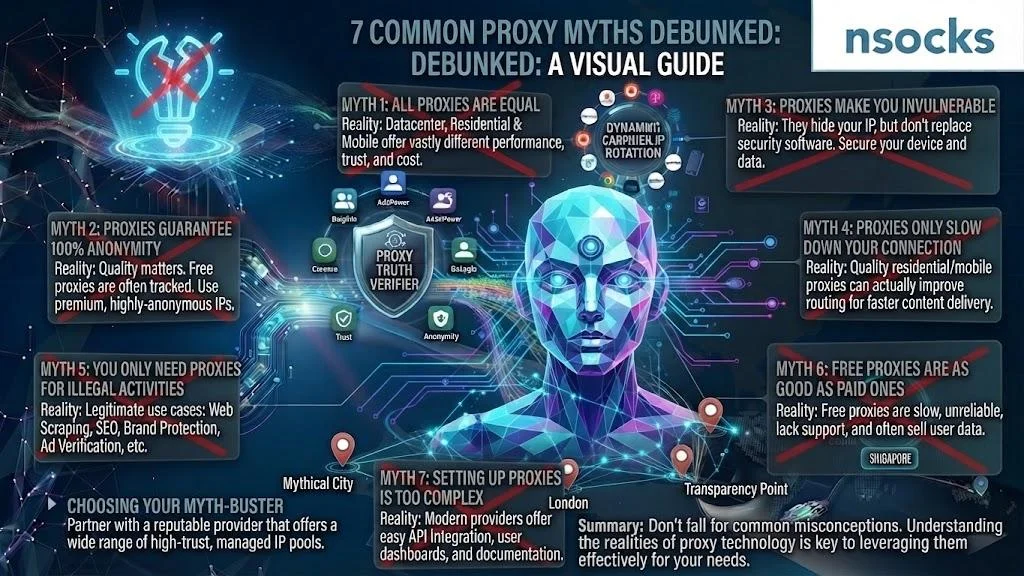
Myth 1: proxies are only for hackers
Reality: this is one of the oldest proxy myths. Businesses use proxies for QA, SEO monitoring, ad checks, API testing, and secure business access.
❌ Myth:
- Only attackers use them
- Normal companies do not need them
✅ Reality:
- Teams use them for testing
- Analysts use them for research
- Developers use them for controlled routing
For example, a marketer may check how a landing page loads from a US location. It is valid when it follows law and platform terms.
Myth 2: proxies are illegal
Reality: are proxies illegal is a common question, and the direct answer is no. In the USA, proxy use is legal when the task itself is legal and respects website rules.
A proxy is a network tool. Using nsocks means confirming that your traffic is for lawful business purposes.
Myth 3: a proxy makes you fully anonymous
Reality: are proxies safe depends on setup, provider quality, and user behavior. A proxy can separate your main IP from selected requests, but it does not remove every trace of activity.
💡 A proxy can help with privacy in controlled workflows, but it should not be treated as total invisibility. Logins, cookies, and device settings still matter.
- Step 1: define the task.
- Step 2: use a clean browser profile.
- Step 3: test the routed session.
- Step 4: document the result.
Myth 4: free and paid proxies are the same
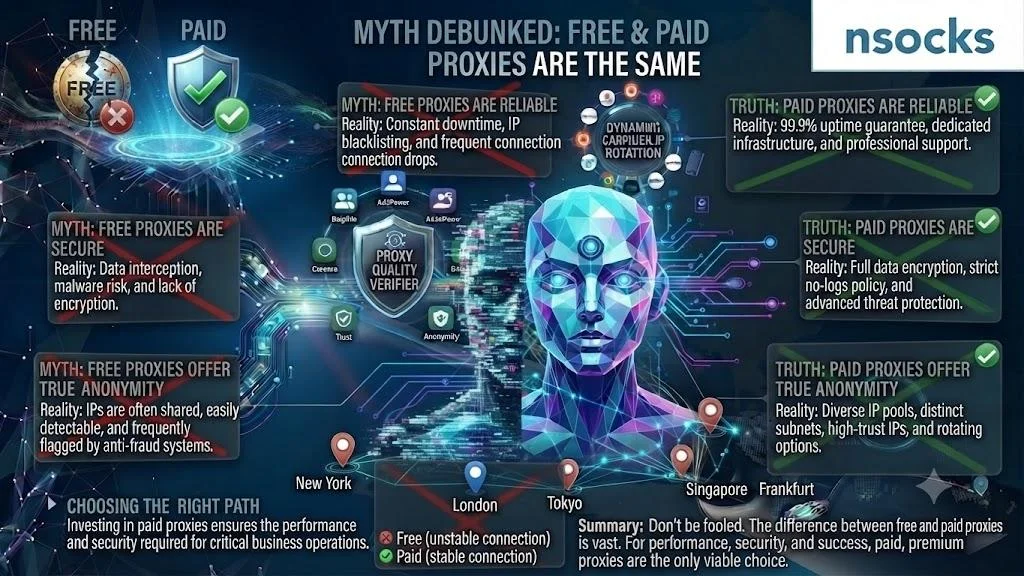
Reality: this is one of the most expensive proxy myths for teams. Free access may look cheaper, but free proxy risks include unstable speed, unclear ownership, weak support, and poor proxy reputation.
| Criterion | No-cost access | Paid access |
|---|---|---|
| Speed | Unstable | More predictable |
| Support | Usually limited | Available |
| Ownership | Often unclear | Clearer |
| Best fit | Short experiments | Business workflows |
Paid access gives better control over location, login data, and cost in $. That matters when reports must be repeatable.
Myth 5: proxies always slow you down
Reality: good routing does not always reduce speed. This proxy myths topic usually comes from testing poor endpoints or using the wrong location.
Connection speed depends on server quality, distance, target website load, and local Wi-Fi. A well-selected endpoint can be fast enough for monitoring, analytics, and QA.
Myth 6: one proxy is enough for everything
Reality: one endpoint rarely fits every job. When teams ask are proxies safe, the better question is whether the setup matches the task.
A long-term SEO monitor, an API test, and a landing page check may need different regions or protocols. Keep clear notes for every team test.
Myth 7: proxies and VPNs are identical
Reality: a proxy and VPN both route traffic, but they do not work the same way. A VPN usually covers the whole device, while a proxy can be set for one browser, app, or tool.
That application level control is useful for business testing. A VPN fits broader device protection.
How to spot a low-quality proxy provider
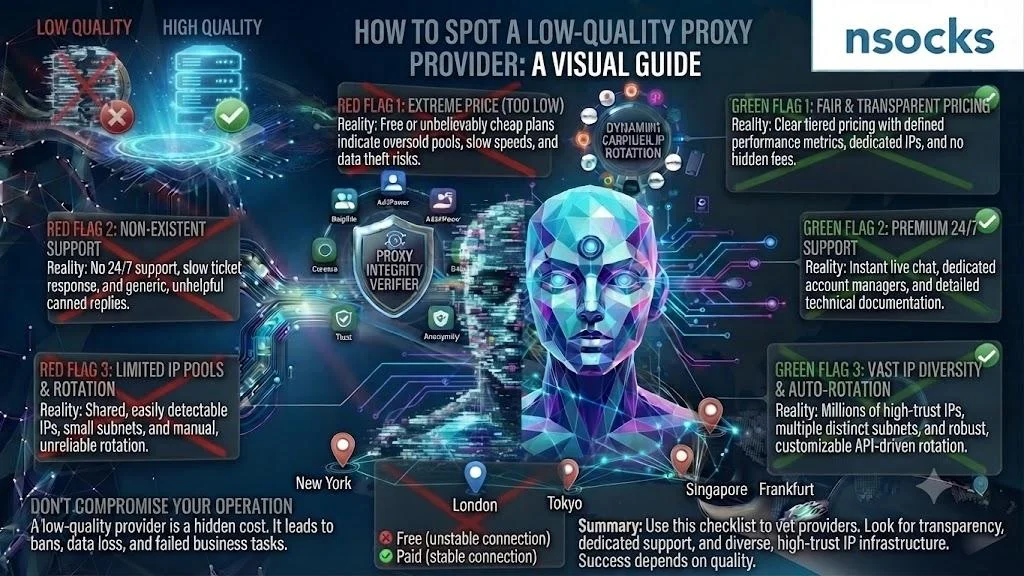
A weak provider creates unstable results, slow work, and unclear responsibility. If someone asks are proxies illegal, one practical answer is to avoid providers that encourage vague or risky use.
❌ Warning signs:
- No clear support
- No setup guidance
- Unclear pricing
- Poor uptime
💡 Check whether the provider explains legal use, regions, speed, and account rules. If details are missing, the service can waste time.
What proxies actually do well
Good proxies support controlled routing, repeatable checks, and cleaner business workflows. When teams ask are proxies safe, the useful answer is to check provider quality, credentials, and task purpose.
✅ Real scenarios:
- QA testing
- Market research
- SEO monitoring
- Ad verification
- API checks
A residential proxy may help when a task needs a realistic network profile.
How to spot a reliable proxy provider
A reliable provider should make setup, testing, pricing, and support easy to understand. When users ask are proxies illegal, a trustworthy service should answer clearly: lawful use in the USA is expected.
| Feature | Benefit |
|---|---|
| US locations | Better regional checks |
| Clear dashboard | Fewer setup mistakes |
| Stable uptime | Cleaner reports |
| Support | Faster issue handling |
| Transparent pricing | Easier $ planning |
Use a small real test before scaling. This confirms speed and stability before larger spending. Try demo first, buy proxies after confirmation, or register for full access for team profiles.
Key takeaways
The main lesson from proxy myths is simple: judge the tool by the task, provider, and setup.
TL;DR for quick review:
- Proxies are business tools when used legally.
- A good provider matters more than a cheap endpoint.
- Total anonymity is not a realistic promise.
- Match each endpoint to one clear task.
- Document purpose, region, and test result.
Frequently asked questions
Are proxies safe to use?
Yes, when they come from a trusted provider, use secure credentials, and support a lawful task.
Are proxies legal?
Yes, proxy use is legal in the USA when the activity itself follows law and website rules.
Do proxies make me completely anonymous?
No. They can separate selected traffic, but browser data, logins, and cookies can still identify activity.
Are free proxies as good as paid ones?
Usually no. Paid access is more suitable for business workflows because it offers clearer support, stability, and control.
Do proxies always slow down my connection?
No. Speed depends on route quality, distance, server load, local network, and the target website.