Price monitoring with proxies for e-commerce
A price monitoring proxy helps e-commerce teams check public prices, stock, and promotions from selected US locations without exposing the office IP. The work is legitimate when it uses public data, respects site terms and robots.txt, and follows reasonable timing.
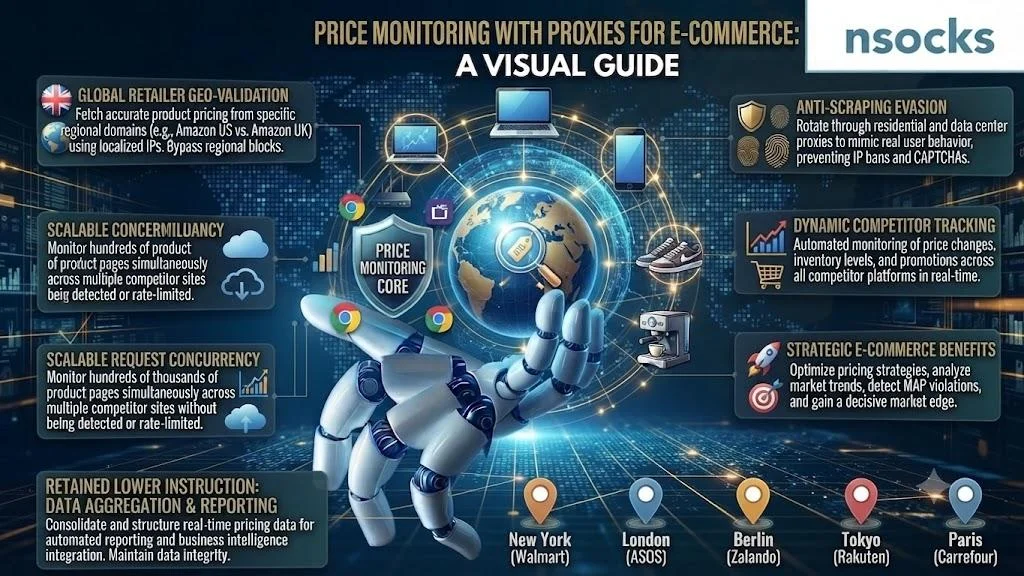
Why price monitoring needs proxies
Proxies provide separate IPs and regional visibility. For competitor price tracking, this means cleaner city-level comparisons without mixing results with office traffic. This keeps reports clear across teams, tools, locations, and recurring campaigns over time.
✅ Useful scenarios:
- Checking public product pages
- Comparing regional offers
- Verifying visible stock
- Reviewing promotions
Each check needs a purpose and schedule.
Which proxy type is best for price monitoring
The choice depends on volume and geography. For ecommerce price scraping, residential access suits local checks, while datacenter access fits faster tasks.
| Proxy type | Stability | Best for |
|---|---|---|
| Residential | High | Local retail checks |
| ISP | Very high | Recurring sessions |
| Datacenter | High | Fast page checks |
| Mobile | Variable | Mobile verification |
Start with one region and expand after validation.
What data you can collect (public)
Public pages may show price, currency, stock, discounts, and promotion dates. A lawful price monitoring workflow records visible information and avoids private accounts or personal data.
Useful fields include time, URL, product ID, region, price, and stock label.
How to set up price monitoring step by step
A reliable workflow starts with fixed fields and realistic timing. For competitor price tracking, define the output before automation.
- Step 1: Choose public pages.
- Step 2: Select US regions.
- Step 3: Pick a proxy type.
- Step 4: Set request intervals.
- Step 5: Store one format.
- Step 6: Review errors.
Test a small sample first. It reveals field and region errors.
How to rotate IPs and set timing

Rotation should match task size. In ecommerce price scraping, IP rotation works best when requests are spread over time.
💡 Start with longer intervals, review errors, and change one rule at a time.
How to structure and store the data
Good storage makes checks useful. A price monitoring dataset should keep the same fields, currencies, and time format.
💡 Save product ID, URL, location, current and previous price, stock state, and time. CSV suits small projects; databases fit larger histories.
How to avoid blocks and rate limits
Respectful requests reduce failures. For competitor price tracking, rate limiting, caching, and smaller batches are safer than high volume.
❌ Avoid:
- Rapid repeated requests
- Ignoring error codes
- Rechecking unchanged pages too often
- Unclear task ownership
If errors rise, pause and review the rules. Never push against technical limits.
Ethical and legal notes (USA)
US teams should collect only permitted information. A lawful ecommerce price scraping process respects terms, robots.txt, copyright, privacy, and contracts.
Large projects may need legal review. Nsocks is for legitimate business use, not private content.
Common issues and fixes
Failures often come from wrong regions, unstable endpoints, changed layouts, or poor timing. A price monitoring process should log errors for fast diagnosis.
| Issue | Cause | Fix |
|---|---|---|
| Wrong price | Regional mismatch | Check location |
| Missing item | Layout changed | Update selector |
| Slow checks | Distant endpoint | Choose closer region |
| Repeated errors | Requests too frequent | Increase interval |
| Duplicate rows | Weak storage rules | Add unique IDs |
Fix one variable at a time. Keep every retest comparable.
Best practices for accurate data

Accuracy needs consistent regions, times, currencies, and page states. For price monitoring, geo targeting should match the audience and each record should show its origin.
💡 Keep a validation sample for manual review.
✅ Good habits:
- Use fixed field names
- Compare current and previous values
- Keep error logs
- Review major changes manually
❌ Weak habits:
- Mixing regions
- Ignoring time zones
- Saving prices without currency
- Treating missing values as zero
How the right proxy supports price monitoring
A suitable service improves stability and location control. For price monitoring, Nsocks supports legal public-page checks, clear credentials, stable sessions, and practical $ planning for competitor pricing analysis.
| Feature | Benefit |
|---|---|
| US locations | Better regional accuracy |
| Stable sessions | Cleaner recurring checks |
| Flexible protocols | Easier tool compatibility |
| Dashboard controls | Faster profile management |
| Support | Quicker troubleshooting |
Start small. Try a demo, buy proxies after validation, or register when more profiles are needed.
Key takeaways
The rules are simple. Keep the task lawful, measurable, and moderate.
- Collect only visible information.
- Match proxy type to the task.
- Use realistic timing.
- Store region and timestamp data.
- Validate unusual changes manually.
Frequently asked questions
Why do I need proxies for price monitoring?
They separate checks from office traffic and help verify regional pages.
Which proxy type is best for tracking prices?
Residential or ISP access suits regional checks; datacenter access suits faster general tasks.
Is price scraping legal?
It can be lawful when it uses public information and respects law, site terms, and contracts.
How do I avoid getting blocked while monitoring prices?
Use reasonable intervals, smaller batches, caching, and stop rules.
How often can I check prices per IP?
There is no universal number. Use site rules and error rates to set a conservative schedule.